


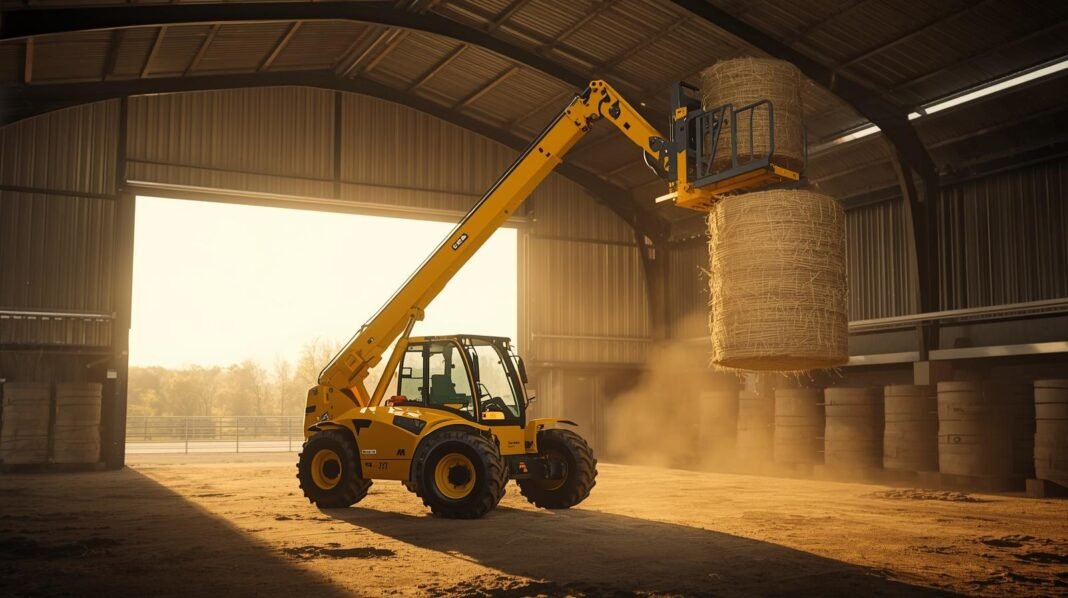

June 2026: Walk onto almost any large farm in the UK or the US today and you will find one. It sits somewhere between the tractor barn and the grain store, its telescopic boom folded down, waiting.
The telehandler — or telescopic handler — has become so embedded in farm operations over the past two decades that many farmers struggle to remember how they managed without one.
That ubiquity is not an accident. The telehandler is one of the few machines that genuinely earns its place across multiple farm sectors, multiple seasons, and multiple tasks — often replacing three or four specialist pieces of equipment in a single purchase.
And with JCB announcing that its flagship Loadall telehandler will be the first product off the line at its new $500 million San Antonio, Texas factory when production begins in October 2026, the machine is having something of a cultural moment.
So why has the telehandler become so indispensable — and how do you choose the right one for your operation?
What a Telehandler Actually Does
At its core, a telescopic handler is a rough-terrain lift truck with an extendable boom arm. Unlike a standard forklift, which lifts loads vertically in front of the machine, the telehandler’s boom extends forward and upward — giving it both lift height and forward reach that a forklift cannot match.
Unlike a front loader on a tractor, it can place loads precisely at height and distance rather than just scooping and tipping.
That combination of height, reach, and precision is what makes it so versatile. On a working farm, a single telehandler with a set of interchangeable attachments can:
- Stack bales in a barn to roof height
- Load grain trailers from a heap or hopper
- Carry and place palletised bags of seed or fertiliser
- Handle post-and-rail fencing or construction materials
- Support building maintenance and roof access with a man cage
- Move and spread bedding in livestock sheds
- Place large water tanks, roofing sheets, or silage covers
The attachment ecosystem is a large part of the story. A standard set of pallet forks, a bucket, a bale spike, and a man cage can cover the vast majority of farm handling needs — often at a fraction of the cost of buying dedicated machines for each task.
The Machine That Replaced Three
Talk to arable farmers in the English Midlands or grain growers in the American Midwest and you hear the same story.
Before the telehandler, operations relied on a patchwork of equipment: a tractor with a front loader for yard work, a hired forklift for palletised inputs, and periodic crane hire for anything that needed to go up high.
Each had its own cost, its own availability window, and its own set of limitations.
The telehandler collapsed that patchwork into a single machine.
And because modern farms run on tight labour, the fact that one operator can handle material movement, stacking, and loading tasks without switching machines or waiting for hire equipment is operationally significant — not just in cost, but in time.
US data from the Association of Equipment Manufacturers consistently shows telehandlers among the fastest-growing segments of the construction and agriculture equipment market.
In the UK, the Agricultural Engineers Association reports steady year-on-year growth in telescopic handler registrations even as tractor sales plateau.
The pandemic-era supply chain squeeze, which made hired equipment harder to source, accelerated on-farm ownership significantly.
Why JCB Built Its Factory Around the Loadall
JCB’s decision to lead production at its San Antonio factory with the Loadall is not arbitrary. The Loadall is JCB’s single best-selling product in North America — a market where telehandler demand has been growing faster than almost any other equipment category.
North America is also the world’s largest market for aerial access equipment, which will be the second product line out of San Antonio.
The overlap is telling: both telehandlers and aerial work platforms serve the same fundamental need — getting people and materials to height safely, efficiently, and on demand.
For large farms with permanent structures, grain facilities, or agri-industrial operations, both machines have a role.
By manufacturing the Loadall locally, JCB projects that 85% of what it sells in North America will be built in North America — reversing a ratio that currently sits at 80% imported.
For dealers and farmers, that has practical implications: faster delivery windows, more predictable parts availability, and pricing less exposed to currency and shipping fluctuations.
Choosing the Right Telehandler for Your Farm
Telehandlers are not one-size-fits-all. Lift height, load capacity, wheelbase, and cab specification vary significantly across the market — and the right machine depends heavily on what you are doing and how often.
| Farm Size / Use Case | Recommended Lift Height | Typical Capacity |
|---|---|---|
| Small Mixed Farm Less than 500 acres |
Up to 7m (23 ft) | 2,500–3,500 kg |
| Arable / Grain Operation | Up to 9m (30 ft) | 3,500–4,000 kg |
| Large Livestock / Dairy Farm | Up to 12m (40 ft) | 4,000+ kg |
| Agri-Construction / Contractor | 14m+ (46 ft+) | 4,000–5,500 kg |
Beyond capacity and height, farmers should consider:
- Transmission type — powershift transmissions suit high-cycle yard work; hydrostatic suits precision placement
- Cab comfort and visibility — operators spend long hours in these machines; cab quality matters for productivity
- Attachment compatibility — check that the hitch system is compatible with your existing or planned attachment inventory
- Dealer network and parts availability — especially relevant now that localised manufacturing is shifting supply chain dynamics
- Resale value — JCB, Manitou, Merlo, and Claas Scorpion telehandlers hold value well in established markets
The Competition: How JCB Stacks Up
JCB dominates the telehandler market — particularly in the UK, where the Loadall has been built since 1977 and is effectively a generic term in farming circles, much as Hoover became synonymous with vacuum cleaners.
In North America, JCB competes primarily with Manitou (French), Merlo (Italian), Caterpillar (through its TH series), and Bobcat.
Each brand has its loyalists and its strengths. Manitou has a strong dealer network in North America and a wide range of agricultural-spec machines.
Merlo is favoured in specialty crops and horticulture for its precision and comfort. JCB’s edge has historically been the breadth of its Loadall range — from compact 6-metre machines suitable for smaller holdings to 20-metre heavy-lift models for large-scale agri-industrial operations — combined with an extensive global parts and service network.
Texas-based manufacturing strengthens JCB’s competitive position in North America specifically: local production means lead times that European manufacturers shipping across the Atlantic simply cannot match.
The Outlook: More Tasks, Smarter Machines
The next generation of telehandlers is arriving with features that were unimaginable a decade ago.
Load management systems that prevent tip-over by calculating boom geometry in real time.
Automated attachment recognition that adjusts hydraulic settings instantly. Cab suspension systems that reduce operator fatigue over long shifts. Some manufacturers are trialling hybrid powertrains for lower-emission yard operations.
For precision agriculture operations, the integration of telehandlers into farm management software — tracking hours, loads, and maintenance intervals — is beginning.
It is not hard to see a near future in which the telehandler communicates directly with the farm’s grain management system to log every trailer loaded and every bag placed.
The fundamentals, though, remain unchanged. Farms need to move heavy things to awkward places efficiently, with minimal labour and maximum flexibility.
The telescopic handler solved that problem 50 years ago.
JCB’s decision to build its most advanced factory around it is a reasonable bet that it will still be solving it 50 years from now.
Also Read
U.S. Tractor Sales Fall 12% in February as Farmers Tighten Belts, AEM Data Shows
Is the John Deere 8RX 540 the Most Powerful Row-Crop Tractor Ever Built?
