


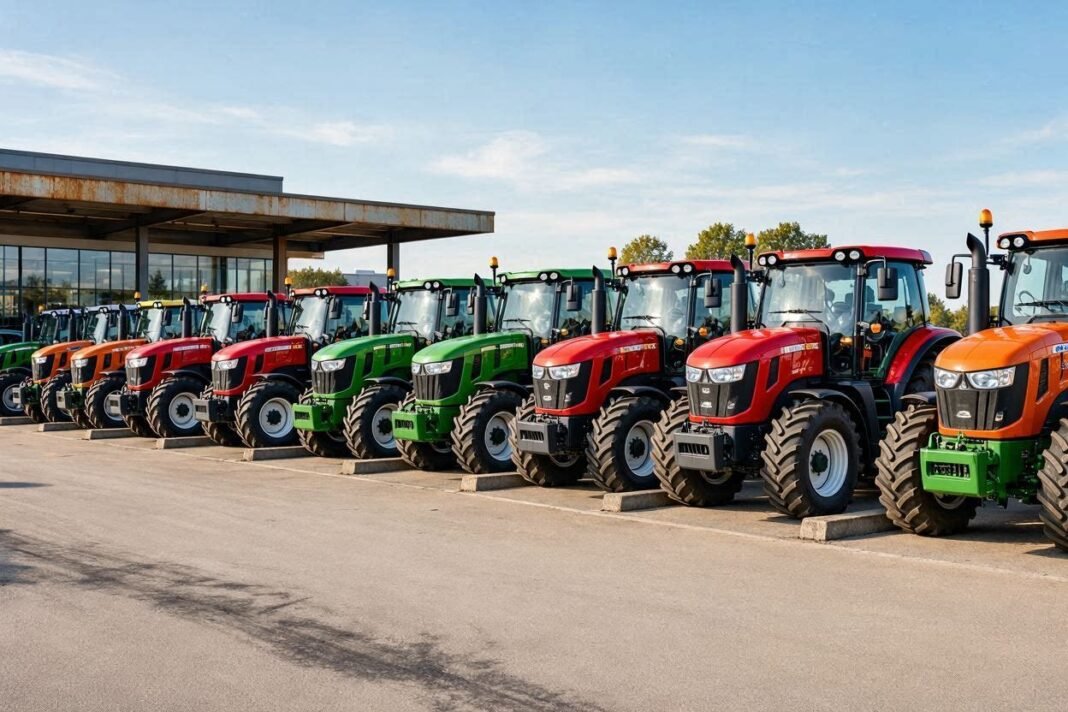

South Africa’s commercial farming sector is one of the most mechanised on the continent, and its tractor market reflects that scale.
From the maize belt of the Free State to the citrus and grape farms of the Western Cape, dependable machinery — and an even more dependable dealer behind it — determines whether a planting season or harvest runs smoothly.
Every year, thousands of farmers converge on NAMPO Park in Bothaville, Africa’s largest agricultural show, where the country’s major tractor brands and their dealer networks compete for attention.
But buying a tractor is a long-term relationship, not a one-off transaction: a dealer’s branch footprint, parts availability and after-sales service matter as much as the machine’s horsepower rating.
This guide looks at ten tractor dealer networks South African farmers turn to most, spanning the major multinational brands and the farmer-owned co-operatives that blend machinery sales with broader agricultural support.
Whether you’re mechanising a smallholding for the first time or replacing an ageing fleet on a large commercial operation, the list below is a starting point for narrowing down where to buy — and what to ask before you sign.
| Category | South Africa Snapshot |
|---|---|
| Leading Brands | John Deere, Case IH, New Holland, Kubota, Massey Ferguson & Valtra |
| Major Farming Regions | Free State, Western Cape, KwaZulu-Natal, Mpumalanga & Limpopo |
| Primary Crops | Maize, wheat, sugarcane, citrus, grapes & soybeans |
| Main Buyers | Commercial farmers, contractors & agribusinesses |
| Flagship Event | NAMPO Harvest Day |
| Why Dealer Support Matters | Access to genuine parts, servicing, warranty support & technical expertise. |
How We Selected These Dealers
The dealerships featured in this guide were selected based on their market reputation, dealer network, after-sales support, availability of genuine spare parts, and representation of leading global tractor brands. We also considered industry experience, technical expertise and their overall contribution to South Africa’s agricultural machinery sector.
1. AFGRI Equipment
AFGRI Equipment is the largest John Deere distributor in the Southern Hemisphere, a relationship dating back to 1963, and today the group runs 47 branches across South Africa, Zimbabwe, Zambia, Botswana and Ghana.
Beyond its tractor and combine range, AFGRI also carries construction and forestry equipment, having been named one of John Deere’s official construction and forestry dealers for Southern Africa in 2021, alongside Senwes Equipment and Mascor.
Its wide branch network and mobile service fleet give it one of the deepest service footprints of any single dealer group in the country, making it a default first call for grain and row-crop farmers wanting factory-trained technicians behind their John Deere tractor.
2. Northmec
Northmec is South Africa’s oldest established agricultural equipment distributor and the country’s sole distributor of Case IH tractors, combines and implements.
Now folded into CNH Industrial’s direct distribution structure alongside its construction division CSE and parts businesses NHSA and Landboupart, Northmec runs 13 branches and roughly 37 further dealer points concentrated in South Africa’s grain-producing provinces.
Its Case IH range spans compact utility tractors through to the flagship Steiger and Quadtrac articulated models used on large-scale grain operations, and it also distributes Case IH’s AFS precision-farming technology — a strong option for farmers investing in GPS guidance alongside new machinery.
3. Senwes Equipment
Senwes Equipment is the machinery arm of Senwes, one of South Africa’s best-known agricultural co-operatives, holding John Deere dealership status across its network in the maize-producing North West and Free State.
Like AFGRI and Mascor, Senwes Equipment was named one of John Deere’s official construction and forestry dealers for Southern Africa, extending its range into excavators, graders and forestry machinery.
Because Senwes operates as part of a broader agricultural services group, farmers buying through it can bundle machinery finance with input supply and grain marketing relationships already held with the co-operative.
4. Mascor
Mascor is a Free State-based agricultural machinery group and the third of John Deere’s named construction and forestry dealers for Southern Africa, alongside AFGRI and Senwes.
Its branch network is concentrated in the central grain belt, and the group has built a reputation for pairing new-machinery sales with a strong used-equipment and trade-in operation, useful for farmers upgrading tractors ahead of a planting season.
As with the other John Deere dealer groups, Mascor’s technicians are factory-trained on John Deere’s precision-agriculture and telematics systems.
5. New Holland Agriculture South Africa
New Holland took direct control of its South African distribution in 2017, opening a branch in Centurion and replacing its former independent distributor.
That move gave the brand direct oversight of a network that included 17 dealers at the time, covering tractors and combines from compact utility models through to large row-crop machines.
New Holland’s South African operation also manages neighbouring markets — Namibia, Botswana, Lesotho and Eswatini — from the same Centurion base.
Because distribution is brand-direct rather than through an independent importer, the local operation can move quickly on financing offers and model launches through its CNH Capital financing arm.
6. Massey Ferguson Dealer Network (AGCO)
Massey Ferguson doesn’t run a single distributor in South Africa; instead, parent company AGCO sells through a network of independent, factory-trained dealers spread across the country’s farming regions, searchable through the brand’s own dealer locator.
The model means service quality varies more by branch than with single-distributor brands, but it also gives Massey Ferguson reach into smaller farming towns than some competitors manage.
Ranges like the MF 300 Xtra and Dyna-VT series, aimed at the 50–260hp bracket common on South African family and commercial farms, are sold and warrantied exclusively through this accredited network — AGCO is explicit that parallel-imported MF tractors fall outside factory warranty and support.
7. Kempston Agri (CLAAS)
Kempston Agri is CLAAS’s official importer for South Africa, distributing the German brand’s Arion, Axion and Xerion tractor ranges through a dealer network that includes outlets such as Tecno Trek Claas in Kroonstad.
CLAAS has built a following among South African grain and mixed farmers for its tractor-and-combine pairing strategy, and its dealers often work alongside co-operatives such as VKB in the Free State grain belt.
As with Massey Ferguson, new-machinery warranty and parts support for CLAAS tractors run through the accredited dealer network rather than private importers.
8. VKB Landbou
VKB is a Free State-headquartered agricultural co-operative whose retail and machinery division sells and services tractors from multiple brands, including CLAAS, alongside its core grain-handling and input-supply business.
For farmers already inside a co-operative relationship for seed, fertiliser or grain marketing, buying machinery through VKB’s retail arm keeps financing and account management under one roof.
Co-operative-linked dealers like VKB tend to be strongest in their home provinces — in VKB’s case, the eastern Free State — so it’s worth checking branch coverage before assuming service reach into other regions.
9. AgroAsia Tractors South Africa
AgroAsia represents a different segment of the market: rather than an OEM-appointed distributor, it supplies brand-new Massey Ferguson, New Holland and John Deere-branded tractors through its own import channel, alongside compact and turf-tyre mini tractors aimed at smallholders, orchards, golf courses and sports facilities.
Its mini tractor range — including Farmtrac, Solis, Simba and Captain models — fills a gap the major OEM networks serve less directly. Farmers considering this route should weigh broader model choice and pricing flexibility against a parts and service network that isn’t backed by the same branch density as AFGRI, Northmec or Senwes.
10. Regional Agricultural Co-operatives
Beyond the named machinery distributors, much of South Africa’s tractor buying happens through regional farmer-owned co-operatives such as GWK in the Northern Cape, OVK in the eastern Free State and TWK in Mpumalanga, which run machinery divisions alongside their grain, input and financing businesses.
These co-operatives typically hold dealership agreements with one or more major tractor brands for their operating region, so the brand on offer varies by co-op and province.
Their advantage lies less in national reach and more in local relationships — many farmers buying through a co-operative have decades of trading history with the same branch, which can matter as much as brand loyalty when it’s time to negotiate finance or trade in ageing equipment.
For first-time buyers unfamiliar with the machinery market, a local co-operative’s advice can also be less brand-driven than a single-franchise dealership’s, since the same branch may carry more than one make.
How to Choose the Right Tractor Dealer
Brand and horsepower aside, a few practical factors separate a good tractor purchase from a frustrating one:
- Branch proximity — a breakdown during planting or harvest is costly; a dealer with a workshop or mobile service unit nearby matters more than a slightly better price further away.
- Parts availability — ask how quickly common wear parts are stocked locally versus ordered from a central warehouse.
- Warranty and authorisation — buying through an accredited dealer protects factory warranty; parallel-imported units often don’t carry the same cover.
- Financing — most major dealers offer in-house or partner financing; co-operative-linked dealers can sometimes bundle this with input or grain-marketing accounts.
- Precision agriculture support — if GPS guidance, auto-steer or telematics matter to your operation, confirm the dealer’s technicians are trained on the specific system.
- Trade-in and resale — dealers with active used-equipment desks make it easier to upgrade machinery as your operation grows.
Did You Know?
South Africa is home to one of Africa’s most advanced agricultural machinery markets and hosts NAMPO Harvest Day—the continent’s largest agricultural exhibition.
Every year, thousands of farmers attend the event to explore the latest tractors, combines and precision farming technologies, making reliable dealer networks and after-sales support essential considerations when investing in new equipment.
Frequently Asked Questions(FAQs)
Frequently Asked Questions
Who is the largest tractor dealer in South Africa?
Several companies operate extensive dealer networks across South Africa. AFGRI Equipment, Northmec, Senwes Equipment and Mascor are among the country’s best-known agricultural machinery dealerships, representing leading international tractor brands.
Which tractor brands are most popular in South Africa?
John Deere, Case IH, New Holland, Massey Ferguson, Kubota, Valtra and Fendt are among the leading tractor brands used by South African farmers.
Can I finance a tractor in South Africa?
Yes. Most major tractor dealerships work with banks and agricultural finance providers to offer financing, leasing and instalment payment options for qualifying customers.
Why should I buy from an authorised tractor dealer?
Authorised dealers provide genuine spare parts, manufacturer-backed warranties, factory-trained technicians and after-sales support, helping to maximise equipment reliability and resale value.
Which tractor is best for South African farms?
The ideal tractor depends on farm size, crops and workload. Compact tractors are suitable for small farms and horticulture, while larger commercial grain and livestock operations often require high-horsepower models with advanced precision farming capabilities.
Editor’s Note:Dealer networks, product availability and brand representation may change over time. Agrimachinery Africa recommends contacting individual dealerships directly to confirm current product offerings, service locations and financing options before making a purchasing decision.
Also Read
- Top Chinese Tractor Brands Making Big Inroads in Africa
- Top 7 Tractor Brands Dominating Africa’s Agricultural Sector
- Top 7 Largest Combine Harvesters in the World (2026 Edition)

Martin is a writer at Agrimachinery Africa specializing in agricultural machinery, mechanization trends, and farm technology across Africa. His work focuses on tractors, harvesting equipment, irrigation systems, and emerging innovations helping farmers improve productivity and efficiency. Through in-depth industry coverage, he highlights technologies shaping the future of modern agriculture.