


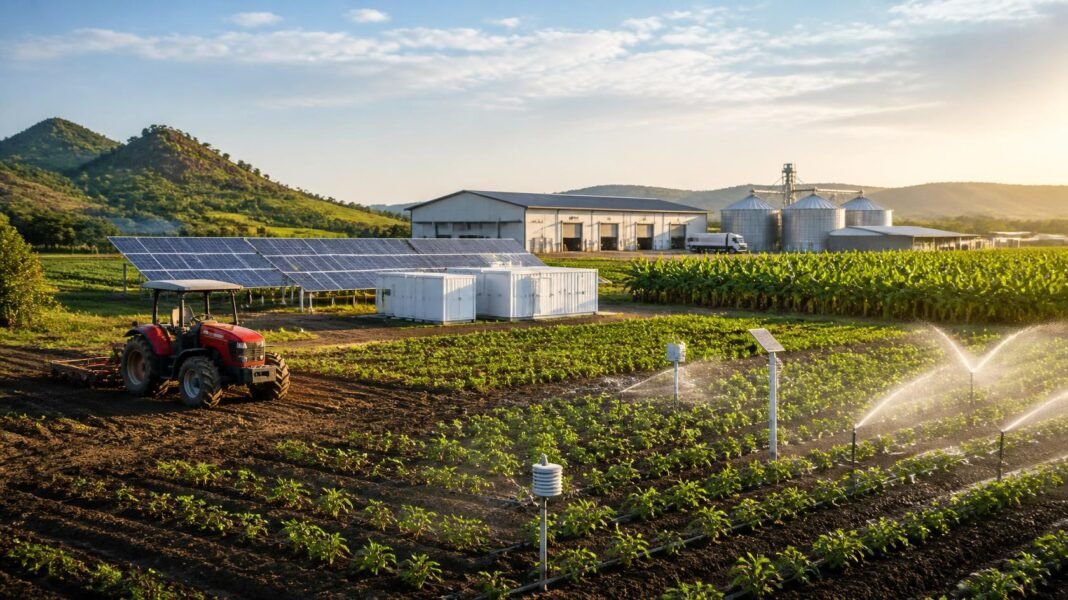

For decades, agricultural mechanisation in Africa has largely been associated with the machines working in the field.
Tractors, planters, harvesters, threshers and other implements remain essential to improving productivity and reducing labour requirements.
But a machine can only solve part of the agricultural equation. Farmers also need reliable energy, water, storage, cooling and access to information if they are to capture the full value of increased production.
This is driving interest in a broader approach to agricultural infrastructure. Projects such as HARVIST in Nigeria are bringing renewable energy, battery storage, smart irrigation, cooling, cold storage, IoT monitoring, artificial intelligence and data analytics into integrated agricultural hubs.
The Infrastructure Gap After Mechanisation
Mechanisation does not happen in isolation. A tractor requires fuel or electricity, maintenance, spare parts and skilled operators, while irrigation equipment depends on reliable power and water infrastructure.
The same applies after harvesting. A farmer can harvest efficiently but still lose value if there is nowhere to store the crop, no cooling for perishables or inadequate transport to the market.
For smallholders, these gaps can have a direct impact on income. A lack of storage may force a farmer to sell immediately, while unreliable electricity can make irrigation or cold storage expensive to operate.
The result is an agricultural system where improvements at one stage can be undermined by weaknesses elsewhere in the value chain.
Producing More Is Only Part of the Challenge
Food loss demonstrates why agricultural productivity needs to be considered across the entire production system. The FAO has highlighted the significant quantities of food lost between production and retail, with post-harvest handling, storage, processing and distribution playing an important role.
For farmers, this is also an economic issue. Every crop lost after harvest represents land, seed, fertiliser, water, labour, energy and machinery that have already been invested.
This makes storage, cooling, drying and improved handling part of agricultural productivity rather than separate from it.
The question is therefore not simply how much farmers can produce, but how much of that production can be preserved and ultimately sold.
Energy Becomes Part of the Farm
Reliable energy is increasingly becoming agricultural infrastructure in its own right. Farms and agricultural facilities need electricity for irrigation pumps, cooling systems, processing equipment, battery charging and digital technologies.
Where grid electricity is unreliable or expensive, diesel generators can provide an alternative, but they add operating costs and expose farmers and agricultural businesses to fuel-price fluctuations.
Solar power combined with battery storage offers another option, particularly for decentralised agricultural infrastructure.
Energy generated during the day can support irrigation and cooling, while batteries can provide power when solar generation falls.
Related Articles
Connecting Energy to Agriculture
The significance of renewable energy goes beyond replacing diesel or grid electricity.
When energy systems are connected to agricultural equipment, operators can potentially manage power generation, storage and consumption as part of the same system.
This creates opportunities for more efficient use of energy across irrigation, cooling, storage and processing.
For smallholders, the ability to combine productive agricultural equipment with dependable energy could become an important factor in expanding mechanisation and modernising farm operations.
Smart Irrigation Connects Water to Production
Water is another area where integration is becoming increasingly important.
Modern irrigation systems can combine pumps, sensors, automation, data and remote monitoring rather than simply delivering water according to a fixed schedule.
The objective is to provide water when and where crops need it while reducing unnecessary consumption. Data can also help farmers and operators understand how irrigation systems are performing.
When irrigation is connected to energy management, water demand and power availability can potentially be managed together. This could help reduce some of the risks associated with both water and energy constraints.
Cooling Can Determine the Value of a Harvest
Some of the most important agricultural infrastructure comes into play after crops leave the field. For fruits, vegetables, dairy, fish and other perishables, temperature management can determine how long produce remains commercially viable.
Without cooling or suitable storage, farmers may have only a short window in which to find a buyer. This can weaken their bargaining position and encourage distress sales during periods of high supply.
Cold storage provides additional time. It can allow farmers, cooperatives and aggregators to hold produce while arranging transportation and seeking suitable markets.
HARVIST’s model places cooling and cold storage alongside renewable energy and irrigation, recognising that these systems can work together rather than being developed independently.
HARVIST’s Integrated Approach
HARVIST — the Hub for Agricultural Resilience through Value-chain, Irrigation, Storage and Technology — is being developed as a UK-Nigeria collaborative project.
The project plans to initially develop three integrated climate-smart agricultural hubs in Nigeria.
The model combines renewable energy, battery storage, smart irrigation, cooling and cold storage, IoT monitoring, artificial intelligence and data analytics.
The HARVIST consortium is led by Nazir Associates Ltd and includes organisations such as the University of Hertfordshire, University of Greater Manchester, KAMIM Technologies Ltd, FarmSpeak Technology Ltd and Yaba College of Technology.
Bringing Technologies Together
The significance of HARVIST lies less in any single technology and more in how the different systems are designed to work together.
A solar installation can provide electricity. An irrigation system can deliver water. A cold room can preserve harvested produce.
But when these systems are connected, they become part of a broader agricultural infrastructure platform capable of supporting production before, during and after harvest.
Data Becomes the Connecting Layer
The digital component is another important part of this model. IoT sensors can provide information about irrigation, energy consumption, storage conditions and equipment performance.
Artificial intelligence and data analytics can then help operators interpret this information and make decisions across the system.
Instead of running irrigation according to a fixed schedule, for example, operators could use information about crop requirements and available resources.
Energy management could also respond to generation, storage and demand.
From Monitoring to Intelligent Management
The value of digital agriculture therefore extends beyond farm-management software. It can become the intelligence layer connecting physical agricultural infrastructure.
Remote monitoring could also help operators identify equipment problems before they become major failures. Over time, this could make agricultural systems more responsive and potentially more efficient.
A Broader Definition of Agricultural Machinery
For agricultural machinery manufacturers, this shift creates a much broader market opportunity.
The African agricultural equipment landscape is no longer limited to tractors, combines and implements.
It increasingly includes irrigation pumps, solar-powered equipment, battery systems, cooling equipment, cold rooms, grain storage, sensors, telemetry, automation and processing machinery.
This creates opportunities for companies traditionally operating outside conventional agricultural machinery.
A pump manufacturer can become part of an irrigation solution. An energy company can support productive-use agriculture, while a refrigeration specialist can become part of the post-harvest system.
The boundaries between agricultural machinery, energy, water technology and digital agriculture are becoming increasingly connected.
From Individual Machines to Agricultural Systems
This does not mean tractors are becoming less important. Across many African markets, access to appropriate mechanisation remains a major constraint on agricultural productivity.
But machinery works best when the surrounding infrastructure can support it. A tractor can prepare land faster, an irrigation system can extend production and a harvester can reduce field losses, but storage, cooling, energy and market connectivity can determine how much of that value is ultimately retained.
The next generation of agricultural investment therefore needs to look beyond individual machines.
Building the Connected African Farm
HARVIST reflects a broader shift in how agricultural infrastructure can be viewed.
Rather than treating energy, irrigation, machinery, storage and digital technology as separate investments, they can increasingly be designed to operate as parts of the same system.
For Africa’s smallholders, this could be particularly important.
The goal is not simply to produce more crops, but to help farmers use resources efficiently, protect what they harvest and reach markets with more of the value intact.
The tractor may remain one of the most visible machines on an African farm.
But the infrastructure behind it — from the power system and irrigation network to storage, cooling, sensors and digital platforms — could increasingly determine how much value that tractor ultimately helps create.
Also Read
- What Kubota’s New BX90 Could Mean for Africa’s Smallholder Mechanisation
- USDA Cuts Global Corn Outlook as Kenya’s Import Requirement Surges
- nside Tanzania’s 10-Year Agricultural Mechanization Plan

Martin is a writer at Agrimachinery Africa specializing in agricultural machinery, mechanization trends, and farm technology across Africa. His work focuses on tractors, harvesting equipment, irrigation systems, and emerging innovations helping farmers improve productivity and efficiency. Through in-depth industry coverage, he highlights technologies shaping the future of modern agriculture.