


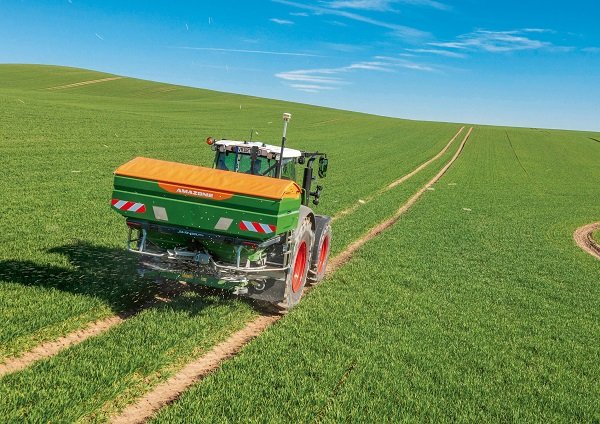

For generations, fertiliser spreaders have relied on a simple principle: set the machine correctly before entering the field, and trust that it will distribute nutrients evenly across every hectare.
Yet there has always been one problem. No two fertilisers behave exactly the same.
Differences in granule size, density, moisture content and manufacturing quality can dramatically alter how fertiliser leaves a centrifugal spreader.
A machine perfectly calibrated for one batch may produce an uneven spread pattern with another, creating strips of over-fertilised and under-fertilised crops.
The consequences are familiar to many farmers—higher input costs, inconsistent crop growth and unnecessary nutrient losses.
For decades, manufacturers responded by improving calibration charts, introducing electronic controls and developing GPS-guided application systems.
These innovations made fertiliser spreading more accurate, but they still depended heavily on one critical factor: the operator selecting the correct settings before work began.
Engineers at German agricultural machinery manufacturer AMAZONE believed there was a better solution. Instead of asking farmers to continually adjust the spreader for changing fertiliser characteristics, why not build a machine capable of adjusting itself?
That question marked the beginning of a long engineering journey that would eventually lead to what AMAZONE describes as the world’s first self-adjusting fertiliser spreader—the ZA-TS 01 AutoSpread.
A Vision That Outlived Its Time
Groundbreaking agricultural machinery rarely emerges from a single engineering breakthrough. More often, it is the result of years of incremental innovation guided by a long-term vision.
For AMAZONE, that vision came from Dr. Heinz Dreyer (1932–2023), the company’s third-generation Managing Director.
Long before artificial intelligence, cloud-connected machinery and autonomous field equipment became common topics within agriculture, Dreyer envisioned a fertiliser spreader that could monitor its own performance and automatically correct itself while working.
At the time, the concept presented enormous technical challenges. Unlike seed drills or sprayers, centrifugal fertiliser spreaders deal with materials whose physical characteristics constantly change.
Even fertiliser from the same manufacturer can behave differently depending on the production batch, storage conditions or moisture content.
Creating a machine capable of recognising those differences—and responding without operator intervention—would require advances in sensors, software, computing power and data analysis that simply did not yet exist.
Rather than abandoning the idea, AMAZONE’s engineers spent years building the technological foundations needed to make it possible.
Solving One Problem at a Time
The journey toward a self-adjusting fertiliser spreader did not begin with AutoSpread.
In 2007, AMAZONE introduced Argus, a spread pattern monitoring system that represented one of the industry’s first major steps towards automated fertiliser application.
Argus monitored the direction in which fertiliser left the spreading discs, allowing the machine to compensate for variations in fertiliser quality that could affect lateral distribution.
For farmers, it was a significant improvement. The system reduced some of the guesswork associated with mineral fertiliser application and helped maintain more consistent spreading performance under changing conditions.
Yet Argus also revealed the industry’s next engineering challenge.
Knowing the direction of the fertiliser was only half the equation.
Engineers still could not accurately determine the distance each fertiliser granule travelled after leaving the machine under real field conditions.
Without that information, it remained impossible to know the machine’s true spread pattern while working.
That missing piece would become the focus of AMAZONE’s next generation of research.
The Challenge No Laboratory Could Solve
For decades, accurately measuring fertiliser throwing distance required controlled testing inside specialised spreading halls.
These facilities allowed engineers to evaluate how different fertilisers behaved under carefully controlled conditions, generating the calibration data farmers relied on in the field.
However, real farming conditions rarely resemble laboratory environments.
Wind speed changes throughout the day. Fertiliser absorbs moisture during storage. Granule quality varies between batches.
Slight differences in density or particle shape can alter the distance fertiliser travels after leaving the spreading discs.
Static laboratory data could only take engineers so far.
To build a truly self-adjusting fertiliser spreader, AMAZONE needed to move the laboratory into the field itself.
That challenge ultimately became the foundation upon which the ZA-TS 01 AutoSpread was built.
Related News
Explore more insights on farm machinery innovation, agricultural equipment manufacturers and dealer networks.
Building a Mobile Spreading Hall
Having identified the missing piece, AMAZONE’s engineers faced an even greater challenge: how could a fertiliser spreader accurately measure its own spread pattern while travelling across a field?
The answer required a complete rethink of how fertiliser application was monitored.
Instead of relying solely on calibration data generated in laboratory spreading halls, the engineering team developed AutoSpread, a system capable of measuring the actual behaviour of fertiliser as it leaves the spreading discs.
Additional sensors mounted on the ZA-TS 01 continuously monitor not only the throwing direction—a capability already introduced with Argus—but, for the first time, the actual throwing distance of the fertiliser.
That achievement transformed the machine into what AMAZONE describes as a mobile spreading hall.
Rather than assuming the spread pattern matches laboratory settings, the spreader analyses what is happening behind the machine in real time.
If the fertiliser behaves differently because of variations in density, granule size or other physical properties, the system automatically adjusts the spreader’s settings to restore an even distribution.
For farmers, this represents a significant shift. Instead of stopping to carry out repeated spreader tests or relying entirely on pre-set calibration charts, the machine continuously validates its own performance while working.
Giving the Spreader a Digital Brain
Building sensors that could monitor fertiliser behaviour solved only part of the engineering puzzle.
The next challenge was interpreting the enormous volume of information those sensors produced.
AMAZONE addressed this by combining AutoSpread with its AmaConnect cloud platform and the Spreader Application Center (SAC). Together, they create what engineers refer to as a digital twin of the fertiliser.
Every fertiliser has unique physical characteristics that influence how it spreads. By comparing live sensor data with reference spread patterns stored within the SAC, the ZA-TS 01 can determine whether the machine is delivering the expected results.
Rather than simply alerting the operator when something appears wrong, the system takes the next logical step—it automatically adjusts the spreader to compensate.
Artificial intelligence plays an important supporting role in this process, analysing live field data and validating the spread pattern against the fertiliser’s digital reference.
Even if mobile network coverage is temporarily unavailable, the machine is designed to continue operating using the information already stored onboard.
The result is a spreader that doesn’t just collect data—it uses that data to make better decisions.
Bringing Precision Farming Systems Together
One of the most impressive aspects of the ZA-TS 01 is that AutoSpread was not developed as a standalone feature.
Instead, AMAZONE’s engineers used it as the foundation for improving every major precision spreading function already available on the machine.
For example, Section Control, which automatically switches spreading sections on and off to reduce overlaps, now bases its decisions on the actual spread pattern measured in the field rather than relying solely on theoretical settings.
The same applies to WindControl, which adapts fertiliser application to changing wind conditions, and HeadlandControl, which optimises application at the ends of fields where overlaps are most likely to occur.
Another major beneficiary is CurveControl. When a tractor turns, centrifugal force naturally alters the fertiliser’s trajectory, increasing the risk of uneven application.
CurveControl compensates for these changes by adjusting the delivery point and metering system as the machine moves through bends, helping maintain a more consistent spread pattern across curved tramlines.
Instead of operating as separate technologies, these systems now work together through AutoSpread, creating a fully integrated precision application platform.
Rethinking Border Spreading
Field boundaries have always presented another engineering challenge.
Farmers must often apply fertiliser differently when working alongside roads, neighbouring fields or waterways, not only to maximise crop performance but also to comply with environmental regulations.
Traditionally, this required operators to manually select different machine settings based on calibration charts and their own experience.
The ZA-TS 01 takes a different approach.
Operators simply enter the distance to the field boundary using the terminal, and the software automatically calculates the appropriate disc speed, delivery point and spread adjustments.
The machine also records these changes automatically, ensuring the as-applied maps accurately reflect the reduced working width and boundary settings.
By combining automation with digital documentation, AMAZONE has simplified one of the most technically demanding aspects of fertiliser application.
Testing the Technology on More Than 100,000 Hectares
Developing an autonomous fertiliser spreader required more than laboratory testing.
Before introducing AutoSpread commercially, AMAZONE subjected the system to extensive field trials covering more than 100,000 hectares.
Those tests exposed the technology to varying fertiliser types, changing weather conditions and different farming environments, allowing engineers to refine both the hardware and software before production.
This lengthy validation process reflects the complexity of building machinery that must make autonomous decisions in constantly changing field conditions.
Every adjustment made by the spreader has to improve application accuracy without creating new inconsistencies elsewhere in the field.
Only after years of refinement did the ZA-TS 01 become ready for commercial introduction.
More Than a New Machine
The ZA-TS 01 AutoSpread represents more than another model in AMAZONE’s fertiliser spreader range.
It demonstrates how agricultural machinery is evolving from equipment that simply follows operator commands into machines capable of sensing, analysing and responding to changing conditions on their own.
For farmers, the potential benefits extend beyond convenience. More accurate fertiliser application can reduce wasted inputs, improve nutrient use efficiency, promote more uniform crop development and support increasingly important sustainability goals.
While the first ZA-TS 01 Ultra models will be available only in limited numbers before a broader market rollout planned for 2027, the engineering principles behind AutoSpread are likely to influence the next generation of precision farming equipment.
Just as GPS guidance transformed field operations two decades ago, self-adjusting machinery could become the next major step in agricultural automation.
Engineering Breakdown: The Technologies Behind the ZA-TS 01
Every innovation inside the ZA-TS 01 was designed to solve a specific limitation that had challenged fertiliser spreaders for decades. Rather than relying on a single breakthrough, AMAZONE combined multiple technologies into one integrated precision application system.
AutoSpread: The Self-Adjusting System
At the heart of the ZA-TS 01 is AutoSpread, the technology that gives the machine its self-adjusting capability.
Unlike conventional fertiliser spreaders that rely on pre-set calibration values, AutoSpread continuously measures the actual spread pattern while the machine is working. If fertiliser characteristics change, the system automatically modifies the spreader’s settings to maintain a uniform application.
This removes much of the manual calibration traditionally required before entering the field.
New Sensor Technology
Developing AutoSpread required engineers to go beyond previous spread pattern monitoring systems.
While earlier technologies such as Argus could monitor the direction in which fertiliser left the spreading discs, the ZA-TS 01 introduces additional sensors capable of measuring the fertiliser’s throwing distance as well.
Knowing both values allows the machine to determine the actual spread pattern instead of estimating it from laboratory data.
AI-Powered Digital Twin
One of the most advanced components is the machine’s digital twin.
As the spreader operates, live sensor data is compared with reference spread patterns stored in the AMAZONE Spreader Application Center.
Artificial intelligence analyses any differences and validates whether the fertiliser is being distributed correctly. If necessary, the machine automatically adjusts its settings without requiring operator intervention.
Intelligent Border Spreading
The software also simplifies one of the most complicated fertiliser application tasks—working along field boundaries.
Instead of manually adjusting several machine parameters, operators simply enter the distance to the field boundary. The ZA-TS 01 calculates the appropriate settings automatically, reducing both operator workload and the risk of application errors.
CurveControl
Spreading fertiliser around bends presents another engineering challenge because centrifugal force naturally alters the spread pattern.
CurveControl continuously adjusts fertiliser delivery as the tractor turns, helping maintain a consistent application across curved tramlines while reducing over-application and untreated areas.
Continuous Machine Monitoring
The engineering team also designed AutoSpread as a diagnostic system.
Because the spreader constantly monitors the actual spread pattern, it can identify worn spreading vanes or developing mechanical problems before they noticeably affect crop performance.
This transforms the machine from simply applying fertiliser into continuously monitoring its own operating condition.
What’s Next for Self-Adjusting Machinery?
The ZA-TS 01 illustrates a wider transformation taking place across agricultural engineering.
Machines are increasingly evolving from operator-controlled equipment into intelligent systems capable of sensing, analysing and responding to changing conditions in real time.
Similar developments are already reshaping tractors, combines and sprayers through automation, artificial intelligence and cloud connectivity.
The same trend is now reaching fertiliser application.
As these technologies mature, future spreaders may automatically recognise different fertiliser products, communicate directly with farm management platforms, optimise nutrient placement for individual crop zones and even predict maintenance requirements before failures occur.
In many ways, the ZA-TS 01 offers a glimpse of what the next generation of precision farming equipment could look like.
The Agrimachinery Africa Take
Every major leap in farm machinery begins with a question that challenges accepted practice.
For AMAZONE, that question was deceptively simple: What if a fertiliser spreader no longer needed the operator to decide whether it was correctly calibrated?
Answering that question required far more than adding new sensors.
It demanded years of engineering, the evolution of earlier technologies such as Argus, extensive field testing across more than 100,000 hectares, and the integration of cloud computing and artificial intelligence into a machine that has traditionally relied on mechanical precision.
The result is the ZA-TS 01 AutoSpread—a fertiliser spreader designed not just to distribute nutrients, but to continuously evaluate and improve its own performance.
Whether self-adjusting spreaders become the new industry benchmark remains to be seen. What is clear, however, is that the ZA-TS 01 marks an important milestone in the evolution of precision agriculture.
As farming increasingly embraces autonomous systems, future machines may spend less time waiting for calibration and more time making intelligent decisions that help farmers produce more with fewer inputs.
Frequently Asked Questions (FAQs)
What is the world’s first self-adjusting fertiliser spreader?
The AMAZONE ZA-TS 01 AutoSpread is described by the company as the world’s first self-adjusting fertiliser spreader.
It uses onboard sensors, intelligent software and AI-assisted analysis to continuously monitor the actual spread pattern and automatically adjust the machine for more accurate fertiliser application.
How does AutoSpread work?
AutoSpread measures both the throwing direction and throwing distance of fertiliser granules as they leave the spreading discs.
This allows the ZA-TS 01 to determine the actual spread pattern in real time. The system then compares this data with reference information from the AMAZONE Spreader Application Center (SAC) and automatically fine-tunes the spreader’s settings to maintain optimum distribution.
Why is a self-adjusting fertiliser spreader important?
Traditional fertiliser spreaders require manual calibration because different fertiliser products vary in size, density and moisture content.
A self-adjusting fertiliser spreader automatically compensates for these differences, helping farmers achieve more uniform nutrient application, reduce fertiliser waste and improve crop performance.
What makes the AMAZONE ZA-TS 01 different from conventional fertiliser spreaders?
Unlike conventional spreaders that rely on pre-set calibration charts, the AMAZONE ZA-TS 01 continuously monitors its own performance while working.
It can automatically adjust spreader settings, optimise Section Control, improve border spreading, enhance CurveControl and validate spreading accuracy throughout the application process.
What is a digital twin in the ZA-TS 01 AutoSpread?
A digital twin is a virtual reference model of a fertiliser’s spreading characteristics. The ZA-TS 01 compares live sensor data with this digital reference through the AMAZONE Spreader Application Center (SAC).
AI-assisted analysis helps determine whether the spread pattern is correct and enables automatic adjustments when necessary.
Can the ZA-TS 01 detect worn spreading vanes?
Yes. AutoSpread continuously monitors the spread pattern and can identify abnormalities that may indicate worn or damaged spreading vanes. By alerting the operator before spreading accuracy is affected, the system supports preventive maintenance and helps protect crop performance.
How was the ZA-TS 01 AutoSpread tested?
According to AMAZONE, the AutoSpread system underwent extensive field testing across more than 100,000 hectares during its development.
These trials allowed engineers to refine the sensors, software and automated adjustment system under a wide range of real-world farming conditions.
When will the AMAZONE ZA-TS 01 be available?
The ZA-TS 01 Ultra will initially be offered in limited numbers with 4,200-litre and 5,000-litre hopper capacities.
AMAZONE plans a broader market launch across additional equipment versions in 2027.
What are the main benefits of the ZA-TS 01 AutoSpread?
Key advantages include:
- Automatic spreader adjustment during operation
- More accurate fertiliser distribution
- Reduced overlap and nutrient waste
- Improved Section Control and CurveControl performance
- Simplified border spreading
- Continuous monitoring of spreading accuracy
- Early detection of worn spreading components
- Better documentation of fertiliser applications
What does the ZA-TS 01 mean for the future of precision farming?
The ZA-TS 01 demonstrates how agricultural machinery is evolving towards greater automation.
By combining sensors, cloud connectivity, artificial intelligence and real-time decision-making, it offers a glimpse into the next generation of precision farming equipment, where machines can optimise their own performance with minimal operator intervention.
Also Read
- Dealer Guide: Top Massey Ferguson Dealers in Africa (2026)
- Top Chinese Tractor Brands Making Big Inroads in Africa
- How Wide Tyres Help Reduce Soil Compaction in Modern Farming

Martin is a writer at Agrimachinery Africa specializing in agricultural machinery, mechanization trends, and farm technology across Africa. His work focuses on tractors, harvesting equipment, irrigation systems, and emerging innovations helping farmers improve productivity and efficiency. Through in-depth industry coverage, he highlights technologies shaping the future of modern agriculture.