


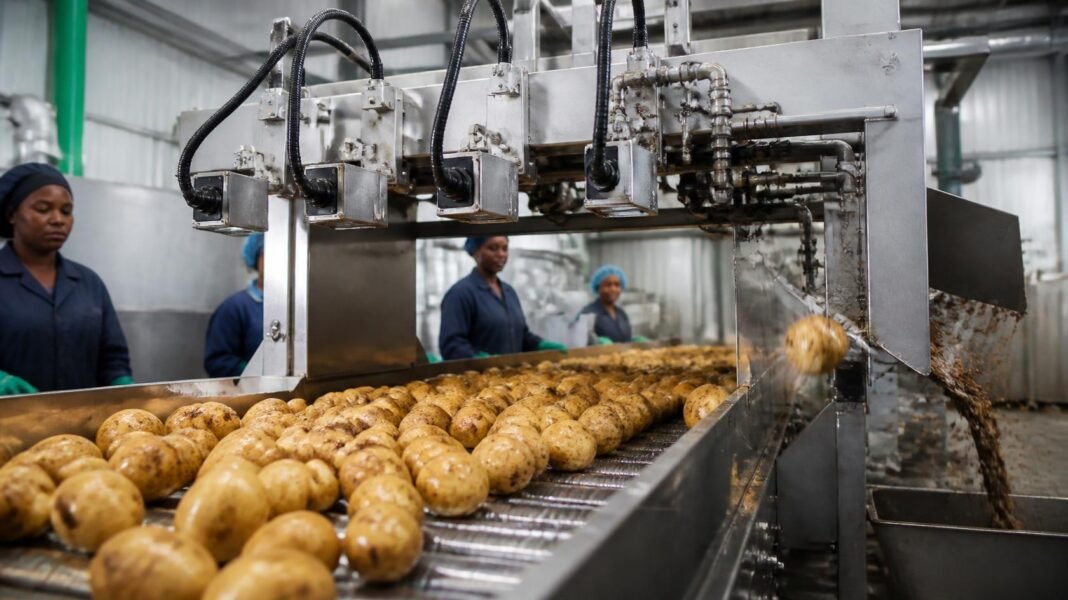

Potato sorting is moving well beyond traditional mechanical grading.
Across modern packhouses and processing plants, cameras, near-infrared (NIR) sensors, lasers and increasingly sophisticated software are being used to identify foreign material, defects and quality differences that conventional grading systems cannot always distinguish.
The reason is straightforward: every unwanted object or defective potato that moves further down the processing line can create another cost.
Stones and soil can damage equipment. Defective potatoes can reduce product quality. Excessive rejection can waste otherwise usable crop.
Manual inspection can also become difficult as processing volumes increase.
Modern optical sorting technology is designed to address these challenges by inspecting individual products at high speed and automatically separating material according to defined quality specifications.
For growers, packhouses and processors, the technology is therefore becoming less about simply removing stones and more about protecting yield, improving consistency, reducing waste and controlling processing costs.
From mechanical grading to optical sorting
Mechanical potato grading remains an important part of post-harvest handling. Screens, rollers, conveyors and other mechanical systems can separate potatoes according to size, weight and physical characteristics while helping remove soil and larger foreign material.
But mechanical equipment has limitations.
Two objects can have similar dimensions while being very different in value. A potato and a soil clod, for example, may be difficult to distinguish using physical separation alone.
Similarly, a potato with a subtle colour defect may pass through a conventional grading system even though it does not meet the processor’s quality specification.
Optical sorting adds another layer of inspection.
Instead of relying primarily on size or physical characteristics, the system uses sensors to examine the material moving through the machine.
Cameras can assess visible characteristics such as colour, shape and surface appearance, while NIR and other spectral technologies can identify differences that are not necessarily obvious to the human eye.
The result is a shift from simply grading potatoes by physical characteristics to making automated decisions about product quality.
How optical potato sorting works
An optical sorter can be thought of as a rapid inspection and decision-making system.
Potatoes or processed products enter the machine and pass through a controlled inspection area. Sensors capture information about each object. Software then compares that information against predefined acceptance or rejection criteria.
Objects classified as unwanted are automatically removed, usually through precisely timed air jets or other ejection mechanisms.
The technology behind this process varies between machines.
Cameras
High-resolution cameras can identify visible differences in colour, shape and surface condition. This can help detect defects, discolouration and unwanted materials that contrast with the acceptable product.
Near-infrared and multispectral sensing
NIR and multispectral systems examine how materials respond to different wavelengths of light.
This provides information beyond ordinary visible imaging and can help distinguish potatoes from foreign materials or identify particular quality characteristics.
Lasers and additional sensing
More advanced sorting systems can combine cameras with laser or other sensing technologies to inspect products from multiple perspectives and identify defects that may be difficult to detect using conventional imaging.
Software and machine learning
The sensors collect the information, but software determines what that information means.
Modern systems increasingly use sophisticated algorithms and m
achine-learning technologies to classify products and improve sorting decisions. This is an important development because it allows sorting equipment to move toward more detailed, data-driven quality control rather than relying only on simple colour or size thresholds.
Sorting starts before potatoes enter storage
The need for sorting begins immediately after harvest.
Freshly harvested potatoes can contain soil, stones, clods, plant material and other foreign objects.
Carrying this material into storage means the grower is effectively storing material that has no commercial value while also increasing the workload for later handling stages.
Pre-sorting can remove a significant portion of unwanted material before potatoes enter storage.
TOMRA’s 3A, for example, is designed for unwashed potatoes and uses colour and multispectral NIR technology to distinguish crop from foreign material. The company lists a capacity of up to 100 tonnes per hour for the system.
The precise value of pre-sorting depends on crop volume, storage arrangements, the amount of foreign material and the wider handling system. For large commercial operations, however, removing unwanted material early can reduce the burden placed on subsequent sorting and processing stages.
It can also help protect equipment further down the line.
Why processors need another layer of sorting
Pre-sorting does not eliminate the need for sorting at the processing plant.
Once potatoes are washed, peeled or processed, the sorting challenge changes.
Processors may need to identify rotten potatoes, discolouration, remaining peel, foreign material, unsuitable shapes or other defects that affect the final product.
This is particularly important in high-throughput operations producing French fries, crisps and other processed potato products.
A foreign object that escapes earlier cleaning stages can become much more expensive if it reaches a slicer or another critical piece of processing equipment. Similarly, rejecting too much good product can reduce yield.
This creates a delicate balance:
Remove the bad product without throwing away good product.
That is one of the most important roles of modern optical sorting.
The economics are about more than labour
It is tempting to evaluate an optical sorter simply by asking how many manual sorting positions it can replace. That is too narrow.
The business case can involve several factors:
- reduced product waste
- improved recovery of usable potatoes
- fewer processing interruptions
- protection of downstream machinery
- more consistent product quality
- reduced manual inspection requirements
- improved throughput
- better control of product specifications
For a large processor, even relatively small improvements in yield can become significant when multiplied across thousands of tonnes of potatoes.
The economics therefore depend heavily on throughput, product value, labour costs, operating hours, reject rates and the cost of downtime.
An optical sorter that makes sense for a large industrial processor may not make economic sense for a small farm or low-volume packhouse.
AI is adding another layer of intelligence
One of the most significant developments in sorting technology is the growing use of artificial intelligence and machine learning.
The basic principle remains the same: sensors collect information and the system makes a sorting decision.
But more sophisticated algorithms can help machines distinguish between increasingly subtle differences in product and defect characteristics.
TOMRA, for example, currently describes machine-learning capabilities across its food-sorting technology, including potato sorting systems.
The significance of AI should not be overstated. Machine learning does not eliminate the need for sensors, good product presentation or appropriate machine configuration.
Instead, it is becoming another tool for turning sensor data into more accurate and adaptable sorting decisions.
This is likely to become increasingly important as processors demand tighter quality specifications while seeking to reduce unnecessary product losses.
The sorter is becoming a data source
Another major change is the move toward connected sorting equipment.
Modern machines can generate information about the material passing through them, machine performance and operating conditions.
When this information is collected and analysed, it can help operators understand variations in production and identify potential maintenance or quality issues.
Cloud-connected platforms such as TOMRA Insight illustrate this wider shift.
The significance is that the sorter is no longer simply a machine that separates good product from bad product. It can become part of a broader digital production system.
The long-term opportunity is to connect sorting information with other parts of the processing operation, allowing processors to make decisions based on actual production data rather than periodic manual observations.
What African potato processors should consider
Advanced optical sorting will not be appropriate for every potato operation in Africa.
For smaller growers, basic cleaning, mechanical grading and manual inspection may remain the most practical solution.
The calculation changes as volumes increase.
Large commercial farms, packhouses and industrial processors have greater potential to benefit from automation because they handle larger quantities and face higher costs associated with labour, waste, downtime and inconsistent quality.
Before investing, buyers should look beyond the headline capacity of a machine.
Important questions include:
- What defects and foreign materials can it detect?
- What is the actual throughput under the intended operating conditions?
- How much good product is rejected?
- Can the machine be integrated with existing equipment?
- What level of operator training is required?
- What maintenance is needed?
- Is technical support available locally?
- How quickly can spare parts be supplied?
- What data does the machine provide?
- What is the total cost of ownership?
For African processors in particular, after-sales support and service infrastructure can be just as important as sorting accuracy.
TOMRA 3A, 5A and 5B show how the technology is evolving
TOMRA provides useful examples of the different stages of modern potato sorting.
The TOMRA 3A is aimed at unwashed potatoes and applications where foreign material needs to be removed early in the handling process.
The TOMRA 5A is designed for potato sorting and grading applications involving washed potatoes and processors, with optical inspection used to identify foreign material and product defects.
The TOMRA 5B represents a more sophisticated approach for processed potato products such as French fries and crisps, combining multiple sensing technologies with software-based classification.
These machines illustrate an important point: there is no single sorting requirement across the potato value chain.
The appropriate technology depends on whether the operation is handling freshly harvested potatoes, stored crop, washed potatoes, French fries, crisps or other specialised products.
Where potato sorting technology is heading
The next stage of development is likely to involve the continued convergence of sensors, machine learning, automation and production data.
Better sensors should allow machines to identify increasingly subtle differences. More sophisticated algorithms can improve classification.
Connected systems can provide processors with more information about what is happening on the line.
The direction of travel is therefore clear: potato sorting is becoming an increasingly intelligent part of the processing operation.
For growers and processors, however, the most important question is not whether the latest technology is available.
It is whether that technology solves a sufficiently expensive problem.
Where waste, labour, downtime, product inconsistency or foreign-material risks are significant, optical sorting can provide another tool for improving the economics of potato handling and processing.
For Africa’s expanding commercial potato and food-processing sector, that could make sorting technology an increasingly important part of the machinery investment conversation.
Also Read
- Kenya’s Tractor Market Gets a Financing Boost as Equity Bank Offers 90% Funding for Kubota Machines
- Why Farm Machinery Makers Are Turning Sustainability into a Profit Strategy
- PotatoEurope 2026 to Showcase Europe’s Largest Live Root Crop Machinery Demonstration

Martin is a writer at Agrimachinery Africa specializing in agricultural machinery, mechanization trends, and farm technology across Africa. His work focuses on tractors, harvesting equipment, irrigation systems, and emerging innovations helping farmers improve productivity and efficiency. Through in-depth industry coverage, he highlights technologies shaping the future of modern agriculture.