


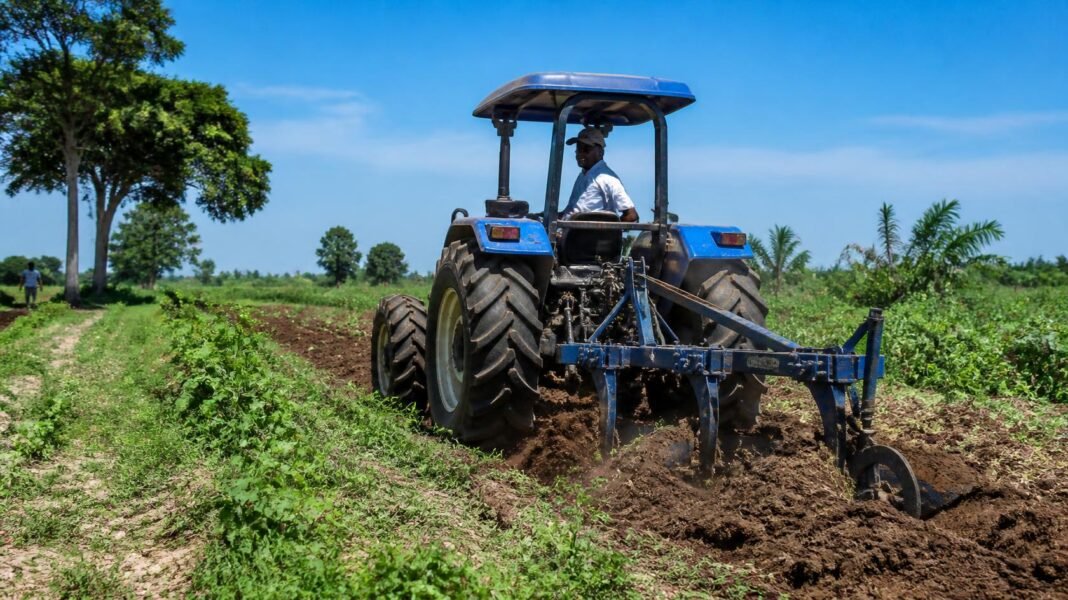

Nigeria would need at least one million tractors to achieve effective agricultural mechanisation and unlock its full farming potential, investment banker and development economist Dr. Nnaemeka Obiareri has opined.
Speaking during an interview on TVC News, Dr. Obiareri argued that large-scale mechanisation, supported by improved storage, processing infrastructure and friendlier import policies, is essential if Africa’s most populous nation is to strengthen food security and become a major agricultural exporter.
His remarks come at a significant moment for Nigeria’s agricultural sector. The country has recently scrapped tariffs on the import of key agricultural machinery as part of efforts to reduce production costs and encourage investment.
At the same time, the government has launched a programme to train 4,000 tractor operators, signalling a renewed commitment to expanding agricultural mechanisation nationwide.
Mechanisation Remains a Major Challenge
Despite possessing approximately 64 million hectares of agricultural land, Nigeria continues to rely heavily on manual labour and low levels of mechanisation, limiting productivity and increasing production costs for millions of smallholder farmers.
According to Dr. Obiareri, Nigeria’s current level of mechanisation falls far short of what is required to build a competitive agricultural economy.
“To mechanise Nigeria’s agriculture effectively, we need one million tractors,” he said during the television interview.
He argued that increasing tractor availability would enable farmers to cultivate larger areas more efficiently, improve productivity and lower the cost of producing food.
Mechanisation, he said, should be viewed as the foundation for a modern agricultural economy capable of feeding Nigeria’s growing population while expanding exports.
More Than Tractors Alone
Dr. Obiareri stressed that tractors alone will not solve Nigeria’s agricultural challenges.
He estimated that the country also requires approximately 25,000 refrigerated trucks to transport fresh produce and significantly reduce post-harvest losses.
According to the economist, post-harvest losses currently cost Nigeria an estimated ₦3.5 trillion annually, largely because farmers lack adequate cold-chain logistics, storage facilities and processing infrastructure.
Without investment in these areas, increased production alone would not translate into higher incomes for farmers or improved food availability.
Related Stories
South Africa Tractor Sales Slip 2% in June 2026 as Farmers Delay Machinery Purchases
South Africa’s tractor market slowed in June as farmers delayed machinery purchases amid economic uncertainty and cautious investment.
Brazil’s Machinery Makers Turn to Export Markets as Domestic Demand Falls 17%
Brazilian agricultural machinery manufacturers are expanding exports as weak domestic demand reshapes the industry’s growth strategy.
CNH Sees Early Signs of Agriculture Recovery Despite Weak Second-Quarter Profit
CNH reports improving agricultural equipment demand while cautioning that global market conditions remain challenging.
Import Reforms Could Accelerate Mechanisation
The economist also criticised policies that increase the cost of importing agricultural equipment.
He argued that high customs duties, bureaucratic delays and import restrictions discourage investors from bringing modern farm machinery into the country.
His comments align with Nigeria’s recent decision to remove tariffs on several agricultural imports, including farm machinery, a move aimed at improving food production and making equipment more affordable for farmers and agribusinesses.
Industry observers say reducing import costs could encourage dealers to expand machinery inventories while making tractors and implements more accessible through financing and leasing programmes.
Combined with operator training, these reforms could help accelerate Nigeria’s long-term mechanisation agenda.
Government Training 4,000 Tractor Operators
Beyond policy reforms, Nigeria has also begun investing in human capital to support mechanised farming.
The government recently launched a programme to train 4,000 tractor operators, equipping young Nigerians with the technical skills required to safely operate and maintain modern agricultural equipment.
The initiative is expected to improve machinery utilisation, reduce equipment downtime and support the wider rollout of mechanised farming services across the country.
Experts have long argued that access to skilled operators is just as important as access to tractors themselves, particularly as governments and private investors expand machinery fleets.
Hunger and Food Security Remain Pressing Concerns
The discussion on TVC News took place against the backdrop of worsening food insecurity across Africa.
According to figures cited during the programme, approximately 645 million people experienced hunger globally in 2025, with 309 million living in Africa. The continent has now overtaken Asia as the region with the highest number of hungry people.
The panellists attributed the situation to a combination of armed conflict, rising fertiliser and energy costs, climate-related disruptions and weak agricultural infrastructure.
The United Nations has repeatedly highlighted the need for greater investment in rural roads, irrigation systems, storage facilities and agricultural value chains to improve food security across the continent.
Leadership and Policy Under the Spotlight
Dr. Obiareri argued that Africa’s greatest agricultural challenge is not a shortage of land but inconsistent leadership and policy implementation.
He noted that Africa possesses more than 800 million hectares of uncultivated arable land, yet the continent imports approximately US$100 billion worth of food every year.
For Nigeria, he said, corruption, policy inconsistency and inadequate investment continue to limit agricultural productivity despite the country’s enormous farming potential.
He called for stable policies that encourage private investment while reducing the cost of acquiring modern agricultural equipment.
Corruption Continues to Slow Agricultural Growth
Another guest on the programme, African affairs analyst Dr. David Matsanga, argued that corruption remains one of the biggest barriers to agricultural development.
According to him, funds intended to support farmers often fail to reach their intended beneficiaries, reducing the effectiveness of government programmes.
He also criticised inadequate investment in irrigation infrastructure and suggested that Nigeria’s education system should place greater emphasis on agriculture as a viable career path for young people.
These structural challenges, he said, continue to undermine efforts to modernise the country’s agricultural sector.
A Vision for Agricultural Transformation
Looking ahead, Dr. Obiareri believes Nigeria could dramatically increase agricultural production if it combines mechanisation with improved infrastructure, better security and investor-friendly policies.
He argued that removing import bottlenecks for agricultural machinery, strengthening rural infrastructure and expanding cold-chain logistics would position Nigeria to become a major agricultural exporter.
While the estimate of one million tractors represents the economist’s assessment rather than an official government target, it underscores the scale of investment many experts believe is necessary to transform Nigerian agriculture.
With tariffs on agricultural machinery being removed and thousands of tractor operators entering training, Nigeria appears to be laying important foundations for greater mechanisation.
Whether these initiatives can bridge the country’s machinery gap will depend on sustained investment, policy consistency and effective implementation in the years ahead.
Also Read
- Why Farm Machinery Makers Are Turning Sustainability into a Profit Strategy
- Tractor Prices in Kenya (2026): New & Used Tractor Price Guide
- Combine Harvester Prices in Kenya (2026): Complete Buyer’s Guide to New and Used Machines

Martin is a writer at Agrimachinery Africa specializing in agricultural machinery, mechanization trends, and farm technology across Africa. His work focuses on tractors, harvesting equipment, irrigation systems, and emerging innovations helping farmers improve productivity and efficiency. Through in-depth industry coverage, he highlights technologies shaping the future of modern agriculture.