


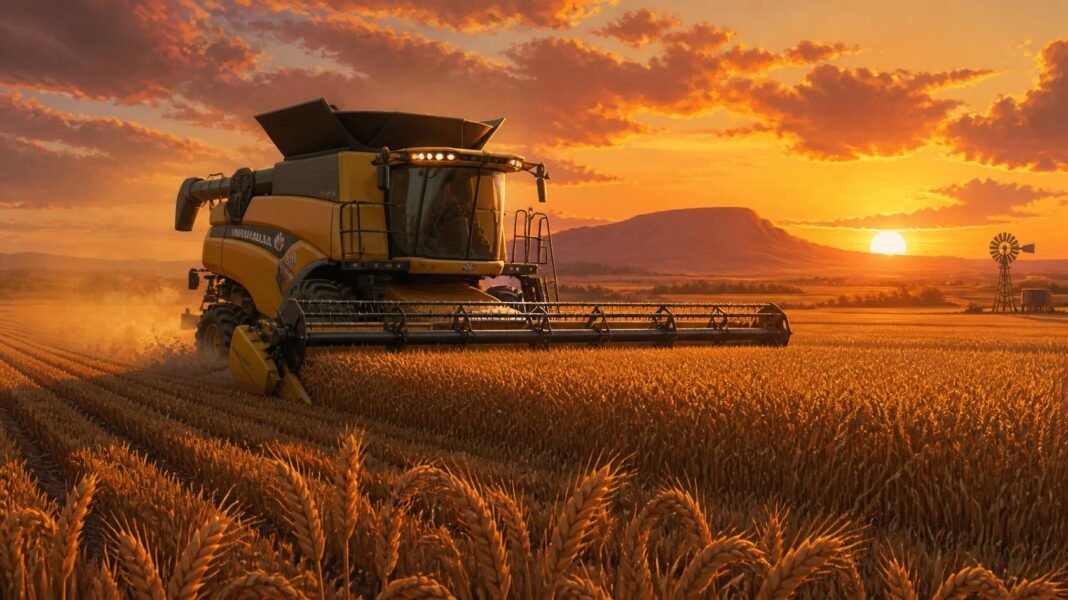

South Africa’s wheat debate is usually framed around food security, imports, producer prices and the future of local production.
But there is another question sitting behind the economics of the crop: what happens to the machinery on the farm when wheat becomes increasingly difficult to produce profitably?
The question matters because modern wheat production depends on a substantial capital base. Tractors, combines, planters, sprayers, precision systems and other equipment are not simply tools sitting on the edge of the farm.
They determine how efficiently a producer can plant, apply inputs and harvest within increasingly narrow production windows.
The issue has gained urgency after the recent Agri in Conversation: Winter Grains – Wheat at a Crossroads discussion at NAMPO Cape, where Grain SA highlighted rising production costs, climate risk, poor returns on capital and structural challenges facing the wheat industry.
South Africa already produces only around half of the wheat it consumes, while the 2026 crop is estimated at approximately 1.7625 million tonnes, 7.5% below the 2025 crop.
For agricultural machinery, however, the important question is not simply how much wheat South Africa will harvest this year.
It is whether farmers will have enough confidence in the crop’s economics to continue renewing the machinery fleet that makes that production possible.
Arthur Bezuidenhout, chairman of the South African Agricultural Machinery Association (SAAMA), says the connection between farm profitability and machinery investment is direct.
“When margins are tight, farmers naturally become more cautious about major capital expenditure,” Bezuidenhout says.
“We are seeing much more emphasis on whether a machine can reduce fuel or input costs, improve efficiency or allow work to be completed more effectively. The return on that investment is becoming increasingly important.”
That shift is significant for machinery manufacturers. In a stronger agricultural cycle, a farmer may be able to justify replacing equipment because the business has generated sufficient cash flow and confidence for the next production season.
When margins tighten, however, a new tractor or combine has to compete with fertiliser, seed, crop protection, fuel, labour, finance and other demands for capital.
The machinery purchase therefore becomes an investment decision rather than simply an equipment decision. And that distinction could become increasingly important in South Africa’s wheat industry.
The farmer can keep the old machine — for a while
One of the simplest responses to difficult machinery economics is also one of the most common: keep the existing machine working for another season.
SAAMA says this is something the industry sees when margins and cash flow come under pressure. “Farmers generally look after their machinery very well, so extending the life of a tractor, combine or implement by another season or two is often a practical option,” Bezuidenhout says.
On paper, this can make perfect financial sense. If the existing machine is paid for, the farmer may prefer to spend money maintaining it rather than committing to a major new capital purchase.
But the calculation changes when reliability begins to deteriorate.
“There is, however, a point where the cost of maintenance and the risk of downtime start to outweigh the benefit of delaying replacement,” Bezuidenhout says. This becomes particularly important during planting and harvesting, when a machinery breakdown can cost a farmer far more than the immediate repair bill.
“Planting and harvesting” are periods when “a few days of downtime can be very costly,” he says.
This creates a machinery dilemma for wheat producers: extending the life of equipment can protect cash flow today, but eventually the cost of keeping older machinery productive can begin eating into the very margins the farmer was trying to protect.
The machinery market is reflecting caution
The wider agricultural machinery market provides another indication of changing investment sentiment, although SAAMA cautions against interpreting national machinery sales as a direct measure of wheat-farmer behaviour.
SAAMA’s machinery statistics cover the broader agricultural economy rather than individual crops. Tractor, combine and implement sales are influenced by conditions across multiple agricultural sectors, normal replacement cycles and regional conditions.
That distinction is important. A decline in national tractor or combine sales cannot automatically be attributed to wheat farmers.
What the figures can provide, however, is an indication of the broader investment environment in South African agriculture.
When farmers have stronger seasons and better cash flow, machinery investment tends to follow. When margins are under pressure and uncertainty increases, capital expenditure becomes easier to postpone.
SAAMA’s chairman says the pattern is clear across the wider agricultural market: “When farmers have had a good season and confidence is positive, machinery replacement and investment tend to follow.
When margins are under pressure and there is greater uncertainty about the next season, farmers become more cautious and capital expenditure is often delayed.”
For wheat producers facing a combination of weaker returns, climate uncertainty and rising production costs, that caution could become increasingly important.
The machinery paradox
This is where South Africa’s wheat problem becomes more complicated.
Farmers need machinery investment because production costs are high. But high production costs and weak returns can make machinery investment harder to justify.
The solution and the problem therefore become intertwined.
Modern machinery can reduce fuel consumption, improve field capacity, reduce overlap, improve application accuracy and potentially reduce the amount of input required to produce a tonne of grain. But these benefits generally require capital investment.
“Mechanisation and technology are part of the solution to improving profitability,” Bezuidenhout says.
He points to better fuel efficiency, more accurate application of inputs, reduced overlap and improved planting and harvesting efficiency as areas where technology can lower production costs.
“The challenge is that farmers need the financial capacity and confidence to make those investments in the first place.”
That may be the most important issue facing the machinery side of South Africa’s wheat debate.
Precision agriculture becomes an economic calculation
The pressure on wheat margins could also change how farmers evaluate technology.
Instead of asking simply whether a machine is newer or more powerful, the question increasingly becomes: how much will this technology save per hectare or per tonne?
SAAMA sees growing importance in GPS guidance, autosteer, precision seeding, variable-rate application, yield mapping, telematics and more fuel-efficient machinery.
The economics are straightforward. If fertiliser, chemicals, seed and diesel are among the largest production costs, even small improvements in application accuracy can accumulate across thousands of hectares.
“For me, the real value of precision agriculture is the ability to use inputs more accurately,” Bezuidenhout says. “With fertiliser, chemicals, seed, and fuel all being expensive, even relatively small efficiency gains across a large farming operation can make a meaningful difference to the cost per ton.”
That is an important shift in the machinery market. The farmer under pressure may not necessarily be looking for less technology. They may be looking for technology with a more demonstrable return.
The Western Cape faces a sharper test
The issue becomes particularly important in the Western Cape, South Africa’s largest wheat-producing region.
Grain SA estimates that the province accounts for approximately 55% of national wheat production, while the 2026 crop is already expected to be substantially below 2025 levels. Severe rainfall deficits in the Swartland have added further uncertainty to production.
For machinery operators, weather risk makes reliability even more important. A farmer operating under difficult climatic conditions has less room for equipment downtime during planting or harvesting.
At the same time, poor production conditions can weaken the cash flow available to replace that equipment.
This is where older machinery becomes a potential strategic problem.
“Farmers can maintain older equipment and keep it productive for longer, but this cannot continue indefinitely,” Bezuidenhout says.
Eventually, maintenance costs rise, downtime becomes more expensive and farmers begin to lose some of the efficiency gains offered by newer machines.
In the Western Cape, where planting and harvesting windows can be tight, the reliability of machinery can become almost as important as its initial purchase price.
It is not just about the price of the machine
The machinery investment decision is also becoming broader.
Farmers are considering not only the purchase price but interest rates, exchange rates, fuel costs, parts availability, after-sales support and the expected performance of the machine over its working life.
That places greater responsibility on manufacturers and dealers.
“The relationship with the farmer goes well beyond selling a machine,” Bezuidenhout says. “Parts availability, after-sales service, technical support, and operator training are critical, particularly when farmers are keeping equipment for longer.”
That could become an increasingly important competitive factor in the South African machinery market.
If farmers are keeping equipment for longer, they need manufacturers and dealers to support those machines for longer too. And if farmers are investing in newer technology, they need confidence that the technology will deliver measurable value in their particular farming operation.
Related Stories:
A wheat problem that extends beyond wheat
The machinery question ultimately brings the wheat debate back to food security.
South Africa already produces only around half of the wheat it consumes. Wheat-based products are consumed by the overwhelming majority of South African households, while the wider wheat value chain supports thousands of jobs and significant economic activity.
If local production continues to decline, the country can import more wheat. But imports do not eliminate the underlying economic question; they shift a larger part of the country’s food system toward international markets, exchange rates, global prices and international supply conditions.
If domestic wheat production becomes less profitable, the consequences can also extend into the agricultural machinery ecosystem — from tractors and combines to planters, sprayers, precision systems, parts suppliers, workshops and dealers.
This is why SAAMA’s warning is broader than machinery sales.
“South African agriculture cannot afford to stop investing,” Bezuidenhout says. “Our farmers compete internationally, and continued improvements in productivity will require investment in better machinery, precision technology, and data.”
The investment paradox South Africa cannot ignore
There is no single machine that will reverse the economics of South African wheat.
The challenges identified at NAMPO Cape include price formation, tariffs, input costs, climate risk, infrastructure, logistics, technology access and producer returns.
But machinery is one of the mechanisms through which farmers turn capital into productivity.
The danger is therefore not necessarily that farmers suddenly stop buying equipment. It is that investment gradually falls behind what the farm requires.
One delayed replacement becomes two. An older tractor stays in service. A combine is maintained for another season. A precision upgrade is postponed. Technology adoption slows.
For one year, the farm may cope. For several years, the cumulative effect can become much more significant.
As Bezuidenhout puts it, if profitability declines for too long, “the machinery fleet ages, maintenance costs increase and the adoption of newer technology slows.”
That is the real machinery warning emerging from South Africa’s wheat crossroads.
South Africa’s wheat industry does not simply need farmers to produce more wheat. It needs them to remain productive enough to make wheat production economically viable.
That requires investment in genetics, agronomy, infrastructure, storage, logistics and, critically, machinery and technology.
The paradox is that the more pressure placed on the economics of wheat production, the more important efficiency becomes. Yet the same pressure can reduce the farmer’s ability to finance the machinery that delivers that efficiency.
The solution, therefore, cannot be to view agricultural machinery simply as another cost that farmers must absorb. It is a productive asset at the heart of South Africa’s agricultural capacity.
South Africa’s wheat debate is ultimately about whether farmers will have enough confidence and financial capacity to keep investing in the machines that make modern wheat production possible.
If that investment continues, technology can help lower the cost of producing each tonne. If it is postponed for too long, South Africa may eventually face a different cost — an ageing machinery fleet, slower technology adoption and declining productive capacity at precisely the moment when food security requires the opposite.
For the machinery industry, that is why the wheat crossroads matters.
And for farmers, the question is becoming increasingly simple:
Can you afford to replace the machine — and, ultimately, can you afford not to?
Also Read
- Agricultural Mechanisation in Africa: Top 10 Most Mechanised Countries
- From Brazil to Africa: Inside Jacto’s Push to Modernise Agricultural Spraying
-
Agricultural Mechanisation in Africa: Top 10 Most Mechanised Countries

Martin is a writer at Agrimachinery Africa specializing in agricultural machinery, mechanization trends, and farm technology across Africa. His work focuses on tractors, harvesting equipment, irrigation systems, and emerging innovations helping farmers improve productivity and efficiency. Through in-depth industry coverage, he highlights technologies shaping the future of modern agriculture.