


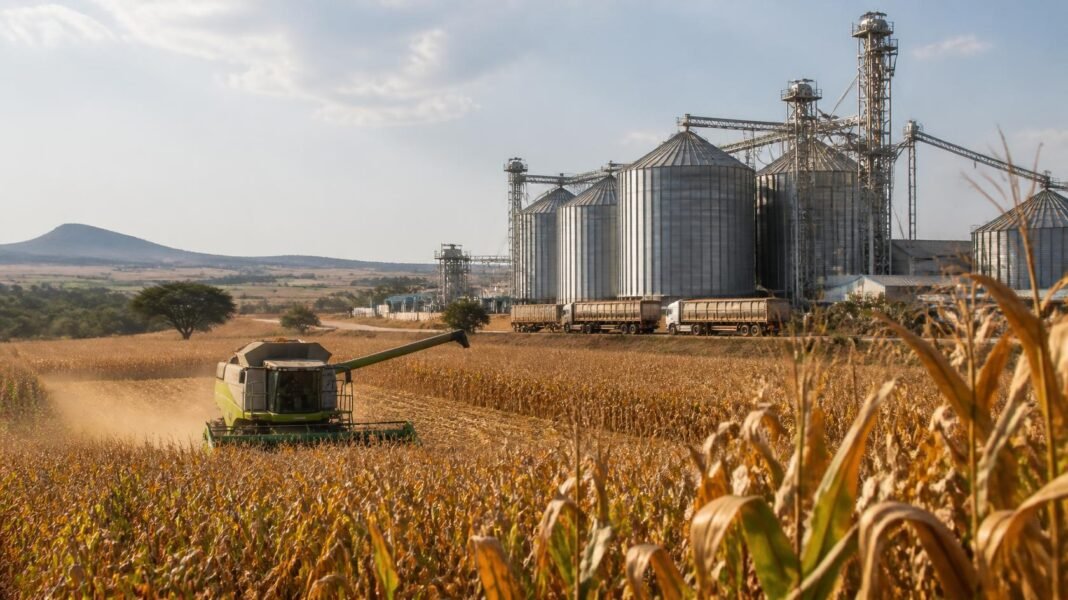

The latest United States Department of Agriculture grain outlook has delivered a more complicated picture for global agriculture
According to the report, the world is still heading toward a very large corn crop, but supplies have been trimmed, global stocks have fallen and several African markets are facing greater pressure to source grain from outside their borders.
For Africa, one of the most significant changes came in Kenya. USDA raised its forecast for Kenya’s 2026/27 corn imports from 700,000 tonnes in August to 1.8 million tonnes in September, an increase of 1.1 million tonnes.
The agency attributed the revision to a “substantial cut” to Kenya’s domestic white-corn production forecast.
That single adjustment changes the significance of the September report for East Africa.
Kenya is not simply becoming a larger buyer in an international grain market; the country could require substantially more grain to move through ports, transport networks, storage facilities, mills and distribution systems during the coming marketing year.
For companies supplying grain handling and post-harvest technology, that creates a potentially important market signal.
USDA trims the global corn balance
The September 11 WASDE report reduced projected global 2026/27 corn production to approximately 1.291 billion tonnes, compared with about 1.299 billion tonnes in the August outlook.
Global ending stocks were also reduced, falling from approximately 274.7 million tonnes to 272.1 million tonnes.
The reduction is not large enough to suggest that the world is facing a corn shortage.
The projected crop remains enormous, and global production is still supported by major producers including the United States, China, Brazil and Argentina.
But the direction of the revision matters.
USDA said global corn production was being reduced by cuts in the United States, India, Kenya and Russia, partly offset by increases in the European Union, Bangladesh, Canada and Paraguay.
Global trade was also forecast slightly lower, while imports were reduced in several markets but increased sharply for Kenya.
The result is a grain market that remains well supplied overall but increasingly differentiated by geography.
Grain can be abundant globally and still be expensive or difficult to obtain in a particular African market when domestic production falls, transport costs rise or local stocks are inadequate.
USDA September 2026: Kenya Maize Outlook
Kenya’s 2026/27 corn import forecast
Increase from August
Rise in projected imports
Source: USDA, Grain: World Markets and Trade, September 2026. Revision linked to a substantial cut in Kenya’s domestic white-corn production forecast.
Kenya becomes the major African story
The Kenya revision is particularly striking because of its size.
USDA’s September estimate puts Kenya’s 2026/27 corn imports at 1.8 million tonnes, compared with just 700,000 tonnes in the August forecast. That means the agency has effectively added another 1.1 million tonnes to the amount of corn Kenya may need to source internationally.
The reason is equally important. USDA cut Kenya’s domestic white-corn production forecast substantially, making the country more dependent on imported grain.
This could have consequences well beyond the commodity trading market.
More imported maize means more grain has to be received, inspected, cleaned, stored, transported and ultimately processed. Ports and inland grain terminals become more important, while millers and grain traders need sufficient storage capacity to manage larger and potentially more volatile flows.
That puts the spotlight on an often-overlooked part of African agricultural infrastructure: the machinery that moves grain after it leaves the farm.
The grain handling opportunity is becoming clearer
When grain production is insufficient, the immediate conversation normally turns to imports.
But imports do not move themselves.
A tonne of maize entering an African market has to pass through a chain of infrastructure that includes port unloading systems, conveyors, elevators, grain cleaners, weighing systems, silos, dryers, trucks, warehouses and milling facilities.
A substantial increase in Kenya’s import requirement therefore potentially creates additional demand for exactly these systems.
For grain handling equipment manufacturers, the opportunity is not necessarily limited to building new mega-silos. Existing facilities may need greater throughput, improved cleaning and drying capacity, better inventory management and more efficient loading and unloading systems.
The economics become particularly important when grain prices are volatile. Operators cannot afford to lose valuable grain through poor handling, excessive moisture, contamination or inefficient storage.
This is where automation and monitoring technology increasingly become part of the grain-security equation.
South Africa remains an important supplier and machinery market
The USDA numbers also show why South Africa remains important in the African grain picture.
USDA estimates South Africa’s 2026/27 corn production at 16.5 million tonnes, unchanged from its August projection.
At the same time, South African corn exports are forecast at 2.6 million tonnes, up from the 2.5 million tonnes projected in August.
That makes South Africa one of the important sources of grain within the wider African market.
The country’s ability to produce a sizeable surplus depends not only on rainfall and acreage, however. It also depends on the productivity of its agricultural machinery fleet, storage infrastructure, logistics network and grain handling systems.
This connects directly with the wider machinery story emerging from South Africa’s agricultural sector.
Farmers facing high input costs need machinery that can reduce fuel consumption, improve planting accuracy, minimise overlap and increase harvesting efficiency. Grain handlers face a similar challenge: they need equipment capable of moving greater volumes with lower losses and operating costs.
The United States is producing less — but still a huge crop
The September WASDE also reduced the U.S. corn outlook.
USDA cut projected 2026/27 U.S. corn production by 213 million bushels, from 16.013 billion in August to 15.8 billion bushels. The average yield estimate fell from 180.7 to 178.5 bushels per acre, while harvested area was reduced slightly to 88.5 million acres.
U.S. corn ending stocks were also reduced from 1.653 billion bushels to approximately 1.567 billion bushels.
Yet the United States is still expected to produce one of its largest corn crops on record.
That distinction is important for African buyers. A smaller U.S. crop does not automatically mean a shortage of corn on world markets.
Rather, the September report suggests that the market is becoming more sensitive to production performance in individual exporting countries and to the ability of those countries to maintain export flows.
Argentina and Brazil become increasingly important
The global corn trade is also being reshaped by the competitive position of South American exporters.
USDA’s September report lowered Brazil’s 2026/27 corn exports from 43 million tonnes to 42 million tonnes, citing stronger domestic demand. Argentina’s exports remained at 40 million tonnes in the September outlook.
USDA’s market analysis also showed that export bids had risen sharply since August. By September 8, the U.S. Gulf corn bid had risen to $252 per tonne, up $30 from August, while Argentina’s Up River bid was $219 and Brazil’s Paranaguá bid was $238.
That price movement matters for import-dependent African countries.
When the cost of internationally sourced grain rises, the value of efficient domestic production, storage and handling increases. Every percentage point of grain loss or unnecessary logistics cost becomes more significant.
Related Stories
- South Africa’s Wheat Crossroads: Can Farmers Still Afford the Machinery They Need?
- Agricultural Mechanisation in Africa: Top 10 Most Mechanised Countries
- Mwea’s Mechanisation Gap: Why Rice Transplanting Remains the Final Frontier
- John Deere’s 2026 Outlook Signals a Possible Turning Point for the Global Farm Machinery Market
Wheat tells a different story
Corn was not the only grain to change in September.
The U.S. wheat production outlook was largely unchanged at approximately 1.531 billion bushels, and U.S. ending stocks remained at 717 million bushels.
USDA did, however, raise the U.S. season-average farm price forecast from $6.20 to $6.40 per bushel.
The bigger change came at the global level.
USDA raised projected 2026/27 global wheat ending stocks from approximately 273.25 million tonnes in August to 276.29 million tonnes in September. That was a surprise relative to market expectations and reflects a somewhat looser global wheat balance than traders had anticipated.
For African wheat importers, this could mean greater availability globally even as individual markets continue to face local production and logistics challenges.
It also highlights why grain markets cannot be understood simply through one crop or one country. Corn, wheat and soybeans are increasingly connected through feed demand, freight, energy prices, livestock markets and farmer planting decisions.
Soybeans provide another signal for machinery markets
The soybean numbers moved in the opposite direction from corn.
USDA raised U.S. 2026/27 soybean production to 4.535 billion bushels, from 4.519 billion in August. Yield increased from 52.7 to 52.8 bushels per acre, while projected U.S. soybean exports increased by 25 million bushels to approximately 1.69 billion.
Despite higher production and exports, U.S. ending stocks were reduced from 320 million to 310 million bushels.
Globally, however, soybean ending stocks were projected at about 124.0 million tonnes, down from approximately 124.2 million tonnes in August.
For agricultural machinery manufacturers, these shifts matter because commodity prices ultimately influence farmers’ ability and willingness to invest.
A stronger crop outlook can support cash flow and equipment purchases in some markets. A weaker production outlook can have the opposite effect.
The machinery market therefore sits downstream from the grain balance sheet, even when the connection is not immediately visible.
What Changed in USDA’s September Outlook?
Kenya corn imports: 700,000 t → 1.8M t
Global corn production: ~1.299B t → 1.291B t
Global corn stocks: ~274.7M t → 272.1M t
U.S. corn production: 16.013B bu → 15.8B bu
Source: USDA, September 2026.
What the September report means for African machinery
The most interesting implication of the USDA report for AgriMachinery Africa is therefore not simply whether corn prices rise or fall.
It is what happens when countries have to move larger volumes of grain across longer distances.
Kenya’s revised import requirement is a case in point. If the country ultimately needs to import 1.8 million tonnes of corn during the 2026/27 marketing year, the physical infrastructure required to handle that grain becomes an important part of food security.
That means more attention to port capacity, inland storage, grain elevators, cleaning systems, dryers, conveyors, trucks and digital inventory systems.
It also reinforces the case for African farmers to increase productivity where possible.
The long-term answer to recurring grain deficits cannot be imports alone.
Higher yields, improved seed, better agronomy, irrigation where viable, mechanisation, precision agriculture and improved post-harvest systems all have a role in reducing the gap between domestic production and consumption.
The machinery market may be watching the same numbers
For machinery manufacturers and grain-handling companies looking at Africa, the September USDA report offers a useful reminder: the opportunity is not only where production is rising.
It is also where production is falling faster than consumption.
Kenya’s 1.1-million-tonne upward revision in corn import requirements is a particularly clear example.
It suggests a potential market for companies involved in grain storage, handling, processing and logistics, while also highlighting the importance of machinery that can help farmers produce more efficiently when land, weather and input costs constrain production.
At the global level, USDA has trimmed the corn balance but stopped well short of signalling a supply crisis. That leaves the market highly dependent on regional production, trade flows and logistics.
For Africa, that may be the most important message from the September report.
The continent’s grain challenge is increasingly becoming an infrastructure challenge as well as a production challenge.
And wherever more grain has to be imported, stored, transported and processed, there will be a growing need for the machinery that makes that movement possible.
Also Read
- South Africa’s Wheat Crossroads: Can Farmers Still Afford the Machinery They Need?
- Agricultural Mechanisation in Africa: Top 10 Most Mechanised Countries
- Mwea’s Mechanisation Gap: Why Rice Transplanting Remains the Final Frontier

Martin is a writer at Agrimachinery Africa specializing in agricultural machinery, mechanization trends, and farm technology across Africa. His work focuses on tractors, harvesting equipment, irrigation systems, and emerging innovations helping farmers improve productivity and efficiency. Through in-depth industry coverage, he highlights technologies shaping the future of modern agriculture.