



As Kenyan farmers contend with high input costs and growing concerns around soil health, attention is increasingly turning towards biological approaches that could complement conventional crop nutrition programmes.
At the Agitech Grand Expo in Mwea, agricultural input companies showcased solutions aimed at helping farmers improve soil conditions while managing the cost of crop production.
Among the voices at the event was Janet Baustina, Sales Advocate at Sumagro, who highlighted the potential role of microbial soil amendments in improving soil health and nutrient utilisation.
For farmers, the appeal of biological soil solutions is closely linked to economics.
As fertilizer and other agricultural input costs put pressure on margins, growers are looking for ways to improve the efficiency of the inputs they already use while maintaining crop performance.
“At Sumagro, we are giving farmers a solution to all that because Sumagro is a pocket-friendly product. You don’t have to apply more than once—you just have one application and you are done.
It fulfills the primary need of a farmer: not spending too much on farm inputs while securing performance,” Baustina said.
Soil health is becoming an increasingly important part of crop productivity as farmers look beyond conventional fertilizer applications and seek to improve nutrient-use efficiency.
The Growing Focus on Soil Health
Crop productivity ultimately depends on more than the nutrients applied during a growing season.
The physical, chemical and biological condition of the soil influences how effectively crops can access water and nutrients.
Where soils have become degraded or nutrient availability is affected by factors such as acidity, farmers can face declining efficiency even when they continue increasing their input applications.
This is where biological soil amendments are attracting greater attention.
Rather than focusing solely on supplying individual nutrients, these products are designed to influence the biological environment around the plant’s root zone.
Baustina said Sumagro is formulated with beneficial microorganisms intended to support soil biological activity and improve the conditions in which crops develop.
“At Sumagro, we are giving farmers a solution to all that because Sumagro is a pocket-friendly product.”
Janet Baustina, Sales Advocate, Sumagro
“Sumagro works directly on the soil. Its formulation contains six distinct types of beneficial microorganisms that work synergistically to balance soil pH and make sure your soil is healthy, giving crops a strong, healthy foundation to grow,” she explained.
The company’s proposition is therefore centred on the soil as the starting point for improving crop performance rather than treating fertilizer as the only solution to declining productivity.
Why Microbial Activity Matters
Soil is a living system containing bacteria, fungi and other microorganisms that interact with organic matter, plant roots and nutrients.
Beneficial soil microorganisms can play important roles in nutrient cycling and the broader biological processes that take place around plant roots.
This has made microbial products an increasingly visible part of conversations around regenerative agriculture and sustainable crop production.
However, their effectiveness can depend on the specific soil conditions, crop, formulation and application programme.
HOW BIOLOGICAL SOIL AMENDMENTS FIT IN
Microbial activity — Beneficial microorganisms can support biological processes in the soil.
Nutrient cycling — Soil biology plays a role in how nutrients move through the root-zone environment.
Root-zone health — Improving the soil environment can support healthier conditions for crop development.
For farmers, the more important question is therefore how a biological amendment fits into the wider crop nutrition strategy.
Rather than necessarily replacing every conventional input, biological products can form part of an integrated approach that combines soil testing, nutrient management, organic matter management and appropriate fertilizer application.
Mwea’s Rice Fields Bring the Issue Into Focus
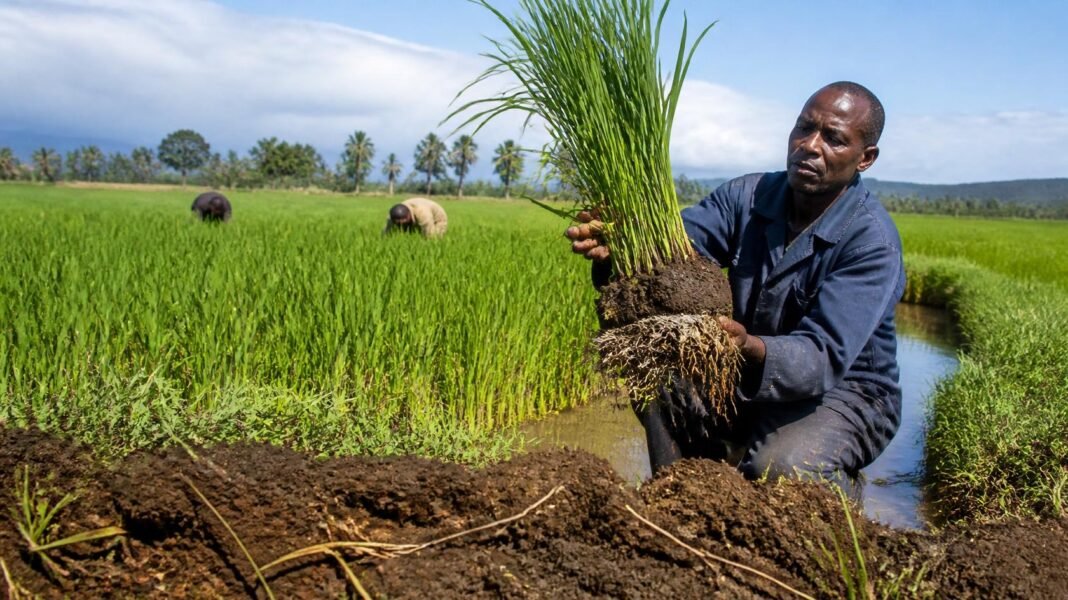
The discussion is particularly relevant in Mwea, where intensive rice production places sustained pressure on agricultural soils.
Rice farming involves repeated cultivation and nutrient removal through harvested grain and straw.
Maintaining soil fertility therefore requires farmers to continually manage the balance between nutrient supply, crop demand and soil condition.
Baustina said biological amendments such as Sumagro could have a role in addressing some of these challenges.
“Using biological amendments like Sumagro improves overall soil health, which is precisely what Mwea rice fields need. By balancing soil acidity and stabilizing pH, it creates an optimal soil environment for rice crops to thrive,” she said.
The claim highlights one of the issues facing farmers beyond the conventional NPK conversation: nutrient availability can be affected by the chemical and biological environment in which the crop is growing.
For rice farmers, improving soil conditions could therefore complement efforts to manage fertilizer applications more efficiently.
MWEA SOIL HEALTH WATCH
Intensive rice production makes soil fertility and nutrient management particularly important. According to Janet Baustina of Sumagro, biological amendments can form part of an approach to managing soil acidity and improving the soil environment for rice production.
Cutting Costs Through Better Input Efficiency
The economic argument for biological soil amendments is closely connected to input efficiency.
Farmers do not necessarily need more products. They need production systems in which the inputs they purchase deliver greater value.
This means understanding the condition of the soil before making decisions about fertilizer and other amendments.
Soil testing can help identify acidity, nutrient deficiencies and other constraints, while crop-specific nutrient programmes can determine what the plant requires during different stages of growth.
Biological products represent another component of that equation.
For farmers considering microbial amendments, the key consideration should be how the product fits into the existing soil and crop-management programme, rather than viewing biological solutions as a standalone replacement for every conventional input.
From Soil Correction to Long-Term Productivity
The renewed interest in soil health reflects a wider shift in agriculture.
For years, productivity discussions have often focused heavily on increasing fertilizer application, improving seed genetics and protecting crops from pests and diseases.
Increasingly, however, farmers and agronomists are looking at the soil itself as an important productive asset.
That means maintaining soil structure, managing acidity, supporting biological activity and ensuring that nutrients remain available to crops.
In regions such as Mwea, where intensive agriculture has made soil management increasingly important, these considerations could become an integral part of maintaining productivity over the long term.
Biological amendments are not a universal solution to every soil problem, and their performance needs to be evaluated within the specific conditions of each farm.
But the growing interest in microbial technologies signals a broader recognition that sustainable crop production begins below the surface.
Crop nutrition is moving beyond simply supplying nitrogen, phosphorus and potassium. Increasing attention is being placed on soil biology, acidity, nutrient availability and the overall condition of the root-zone environment.
A New Layer of Crop Nutrition
The conversation at Agitech demonstrates how crop nutrition is expanding beyond the traditional focus on nitrogen, phosphorus and potassium.
Farmers are increasingly being presented with technologies designed not only to supply nutrients, but also to influence the environment in which those nutrients become available to crops.
For companies such as Sumagro, that creates an opportunity to position biological soil amendments as part of a wider transition towards more efficient and sustainable agricultural production.
For farmers, the underlying question remains practical: can improving the soil reduce the amount of input required to achieve a productive crop?
As Kenya’s agricultural sector searches for ways to improve yields while controlling production costs, biological soil technologies are likely to remain an increasingly important part of that conversation.
Also Read

Martin is a writer at Agrimachinery Africa specializing in agricultural machinery, mechanization trends, and farm technology across Africa. His work focuses on tractors, harvesting equipment, irrigation systems, and emerging innovations helping farmers improve productivity and efficiency. Through in-depth industry coverage, he highlights technologies shaping the future of modern agriculture.