



Sustainability is no longer just an environmental objective for farm machinery manufacturers. It is increasingly becoming a business strategy aimed at helping farmers improve profitability while reducing their reliance on expensive inputs.
During a recent webinar hosted by Equity Bank, Valerio Domenici, Marketing Manager at CNH, outlined how the global agricultural equipment manufacturer is developing technologies that enable farmers to produce more while using fewer resources.
Rather than presenting sustainability as an added cost, Domenici described it as a practical way of improving efficiency, reducing waste and lowering production costs.
“Our goal is using lower inputs to get higher output,” Domenici told participants, summarising CNH’s vision for the future of agricultural mechanisation.
The presentation reflected a broader trend taking place across the agricultural machinery industry. Manufacturers are no longer competing solely on engine power, lifting capacity or machine size.
Increasingly, they are investing in precision farming, digital agriculture, automation and alternative fuels to help farmers maximise productivity while improving profitability.
Producing More With Less
For decades, machinery innovation focused on building larger and more powerful equipment capable of covering more hectares in less time.
Today, the industry’s priorities are changing.
Manufacturers are developing smarter machines that use data, sensors and automation to optimise every litre of fuel, every kilogram of fertiliser and every hectare of farmland. The objective is simple: produce more while consuming fewer resources.
For farmers, this translates into several practical benefits:
- Lower fuel consumption
- Reduced fertiliser and crop protection costs
- Improved planting and spraying accuracy
- Reduced machine downtime
- Better field efficiency
- Increased productivity per hectare
- Lower overall production costs
As production costs continue to rise worldwide, improving efficiency is becoming just as important as increasing yields.
Precision Farming Is No Longer Reserved for Large Farms
One of the strongest messages from Domenici’s presentation was that precision farming should not be limited to large commercial farming operations.
He explained that advanced farming technologies should become accessible to farmers operating older equipment as well as those purchasing new machinery.
To support this goal, CNH showcased its FleetPro Guidance Kits, which allow compatible tractors to be upgraded with GPS guidance systems without requiring farmers to replace their existing machines.
Instead of investing in an entirely new tractor, farmers can retrofit guidance technology that improves steering accuracy, reduces overlaps and lowers input waste.
One presentation slide noted that not every farmer requires the latest premium machinery to benefit from precision agriculture.
For many producers, particularly in developing markets, affordable retrofit technologies could provide a practical entry point into digital farming.
Related Articles
Continue exploring our latest tractor guides and market insights:
Agriculture 4.0 Is Moving From Concept to Reality
Domenici also demonstrated how modern agriculture is evolving into a fully connected digital ecosystem often referred to as Agriculture 4.0.
Instead of operating independently, tractors, sprayers, combines and implements now communicate through integrated software platforms that collect, analyse and share data in real time.
CNH’s precision farming ecosystem includes technologies such as:
- GPS and GNSS guidance
- Auto-steering systems
- Real-Time Kinematic (RTK) correction
- Smart sensors
- Variable-rate application technology
- Yield mapping
- Soil and crop sensing
- Fleet telematics
- Farm Management Information Systems (FMIS)
- Cloud-based connectivity through FieldOps
These technologies enable farmers to make more informed decisions throughout the production cycle while reducing unnecessary fuel consumption and input waste.
Raven Technology Is Expanding Precision Farming
During the webinar, Domenici also highlighted Raven technology as a key component of CNH’s precision agriculture strategy.
Raven provides guidance, steering and field management technologies designed to improve operational accuracy and simplify precision farming.
By integrating Raven systems into its machinery portfolio, CNH aims to make advanced farming technologies more accessible while helping operators complete field work with greater consistency and efficiency.

For farmers, improved guidance accuracy means fewer overlaps during planting, spraying and fertiliser application, resulting in lower operating costs and better resource utilisation.
Intelligent Combine Harvesters Are Changing Harvesting Operations
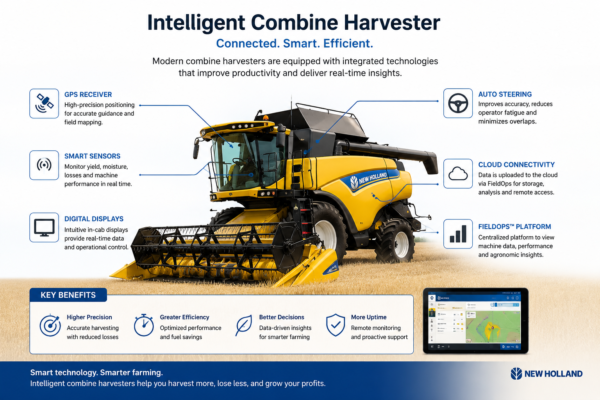
The presentation also demonstrated how combine harvesters are becoming intelligent machines capable of collecting and analysing valuable operational data while harvesting.
Modern combines integrate multiple technologies, including GPS receivers, smart sensors, automated steering systems, digital displays and cloud connectivity through FieldOps.
Instead of functioning solely as harvesting machines, they continuously monitor machine performance and field conditions throughout the harvesting season.
The data generated can help farmers improve harvesting efficiency, monitor grain losses, optimise machine settings and support future crop management decisions.
As agriculture becomes increasingly data-driven, combines are evolving into connected machines that provide valuable insights beyond harvesting alone.
Turning Farm Waste Into Fuel
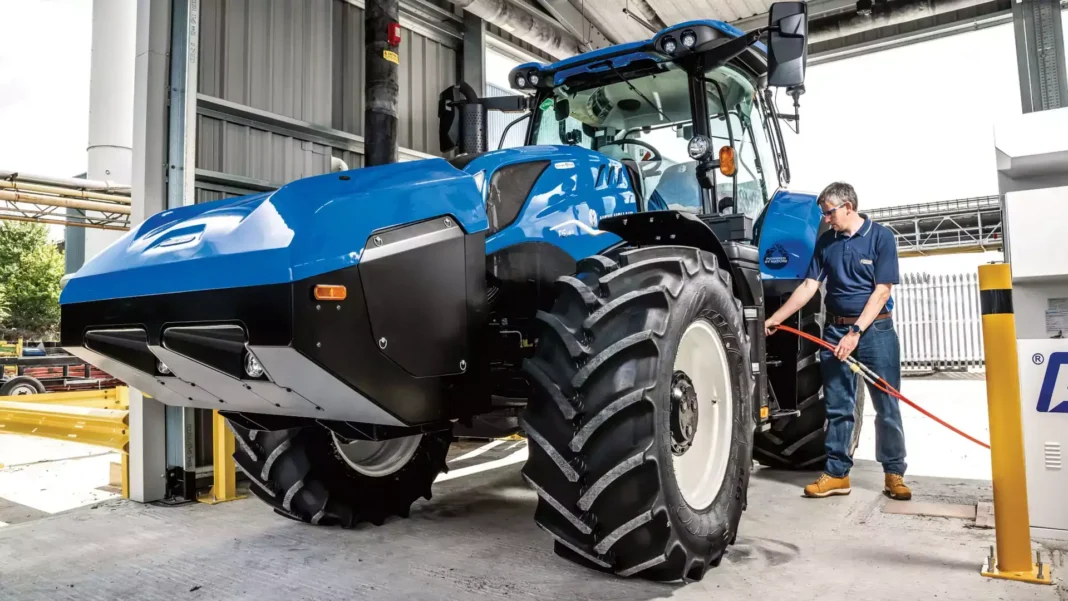
One of the most innovative technologies showcased during the webinar was the New Holland T6.180 Methane Power tractor.
Unlike conventional diesel-powered tractors, the machine is capable of operating on methane gas produced either from conventional natural gas or biomethane generated through anaerobic digestion of livestock manure and crop residues.
The concept forms part of what CNH describes as a circular farming economy.
Instead of treating livestock manure and agricultural waste as disposal challenges, farmers can convert these materials into renewable fuel capable of powering farm machinery.
According to figures presented during the webinar, methane-powered tractors can significantly reduce exhaust emissions while delivering performance comparable to diesel-powered equipment.
Beyond environmental benefits, the technology offers an opportunity for farms with biodigesters to reduce fuel costs and improve energy independence.
Building a Circular Agricultural Economy
The presentation illustrated how methane-powered machinery fits within a broader circular farming system.
- Livestock manure is collected.
- Crop residues are recovered after harvest.
- Organic waste is processed through anaerobic digesters.
- Biomethane is produced to fuel tractors and other farm equipment.
- The remaining digestate is returned to fields as organic fertiliser.
This approach transforms agricultural waste into valuable resources, reducing disposal costs while improving nutrient recycling and lowering dependence on fossil fuels.
Although methane-powered machinery is still emerging across much of Africa, the continent’s extensive livestock sector and abundant agricultural residues provide significant long-term potential for biogas production.
Financing Is Becoming Part of Sustainable Mechanisation
Technology alone cannot transform agriculture without access to finance.
Recognising this, Equity Bank outlined how its mechanisation programme extends beyond equipment financing to support farmers throughout the machinery ownership cycle.
The programme includes:
- Strategic partnerships with agricultural equipment manufacturers
- Higher financing options for machinery purchases
- OEM-supported after-sales services
- Insurance solutions
- Financing for servicing and spare parts
- Farm assessments
- Farmer demonstrations and training programmes
Such initiatives help reduce the financial barriers that continue to limit mechanisation across many African farming communities.
Why This Matters for Africa
The technologies presented during the webinar have particular relevance for African agriculture.
Across the continent, farmers continue to face rising fuel prices, expensive fertiliser, labour shortages and limited access to modern machinery.
At the same time, governments are increasing investment in mechanisation programmes to strengthen food security and improve agricultural productivity.
Precision farming technologies offer an opportunity to reduce input costs while increasing efficiency without necessarily replacing entire machinery fleets.
Retrofit guidance systems, digital farm management tools and connected machinery can help farmers make better use of the equipment they already own.
Similarly, Africa’s large livestock population and significant volumes of agricultural residues create favourable conditions for future biomethane production.
While methane-powered tractors are unlikely to replace diesel machines overnight, they demonstrate how renewable energy could gradually become part of commercial farming operations across the continent.
For African farmers, the greatest value of these technologies may not lie in reducing emissions alone, but in lowering production costs, improving productivity and making farming businesses more resilient.
Sustainability Is Becoming Agriculture’s Next Competitive Advantage
The transformation taking place extends well beyond a single manufacturer.
Across the agricultural machinery industry, companies are investing heavily in automation, artificial intelligence, digital agriculture, precision farming and alternative fuels as they seek to improve farm productivity while reducing operating costs.
Increasingly, the success of modern agricultural equipment is measured not simply by engine horsepower but by how intelligently it helps farmers manage fuel, fertiliser, labour and time.
As Valerio Domenici observed during the webinar, the goal is straightforward: achieve higher output while using fewer inputs.
That philosophy is likely to define the next generation of agricultural machinery.
For African agriculture, where every litre of fuel, every bag of fertiliser and every hectare counts, sustainability is no longer just an environmental aspiration.
It is rapidly becoming one of the agricultural machinery industry’s most important profit strategies.
Also Read

Martin is a writer at Agrimachinery Africa specializing in agricultural machinery, mechanization trends, and farm technology across Africa. His work focuses on tractors, harvesting equipment, irrigation systems, and emerging innovations helping farmers improve productivity and efficiency. Through in-depth industry coverage, he highlights technologies shaping the future of modern agriculture.