




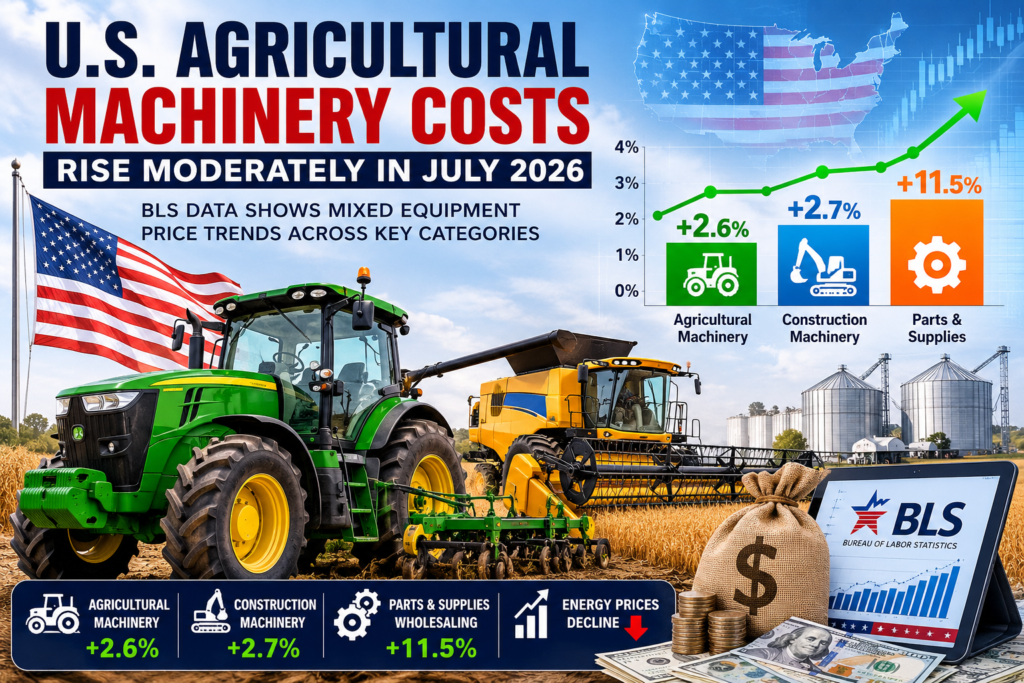
Prices for agricultural machinery and equipment in the United States increased 2.6% over the 12 months to July 2026, according to new U.S. Bureau of Labor Statistics data, while construction equipment prices rose 2.7%.
The latest Producer Price Index data provide a detailed look at the cost environment facing machinery manufacturers, dealers, farmers and contractors.
While the overall U.S. Producer Price Index for final demand was unchanged in July, several machinery categories continued to record annual price increases.
Agricultural machinery and equipment prices increased 0.1% in July and were 2.6% higher than a year earlier.
Construction machinery and equipment performed slightly more strongly, rising 0.7% during July and 2.7% over 12 months.
The figures indicate that machinery prices remain under upward pressure even as energy prices decline.
Agricultural machinery prices edge higher
The BLS reported that agricultural machinery and equipment prices increased 0.1% in July.
The category also recorded monthly increases of 0.1% in June and 0.2% in April, while remaining unchanged in May.
Over the 12 months to July, agricultural machinery and equipment prices increased 2.6%.
That is a relatively moderate increase compared with several other industrial equipment categories.
For example, electronic components and accessories increased 28.0% over the year, communication and related equipment rose 12.5%, and transformers and power regulators increased 7.6%.
Agricultural machinery therefore remained relatively stable compared with some technology-intensive equipment categories.
Related Stories
Construction machinery rises faster
Construction machinery and equipment prices increased 0.7% in July.
That was the strongest monthly increase in the agricultural and construction equipment categories shown in the BLS table.
The category was 2.7% higher than a year earlier.
The increase is significant for contractors and equipment dealers because it comes while U.S. construction prices themselves are rising rapidly.
The BLS reported a 2.2% increase in final-demand construction prices in July.
That means contractors are facing higher prices both for construction output and for some of the machinery required to deliver projects.
Pumps and compressors increase 1.1%
Prices for pumps, compressors and equipment increased 1.1% in July.
The category was 3.9% higher over the year.
These products are important across agriculture, construction, mining, manufacturing and water infrastructure.
The monthly increase therefore adds to the cost pressure facing businesses investing in equipment that supports irrigation, water handling, industrial processing and heavy construction.
Mining equipment prices remain elevated
Mining machinery and equipment prices increased 0.2% in July.
The category was 3.8% higher than a year earlier.
That increase is particularly relevant for mining companies and equipment suppliers because it comes alongside continuing price pressure across several industrial inputs.
General-purpose machinery and equipment prices were 0.5% higher in July and 5.6% higher over 12 months.
Internal combustion engines increased 0.3% during July and were 4.8% higher than a year earlier.
Machinery parts are becoming more expensive
One of the most important findings for equipment owners is the increase in machinery parts and supplies.
Prices for machinery and equipment parts and supplies wholesaling increased 2.0% in July.
Over the year, the category was 11.5% higher.
This is considerably stronger than the 2.6% annual increase recorded for agricultural machinery itself.
That difference matters.
Even if the purchase price of a new tractor, combine, harvester or other agricultural machine is rising moderately, the cost of maintaining and supporting that equipment can increase much faster.
For machinery dealers and fleet operators, parts inflation can therefore become an increasingly important operating-cost issue.
Machinery and vehicle wholesaling moves sharply lower
At the same time, another part of the equipment distribution market moved sharply in the opposite direction.
The BLS reported a 9.0% decline in machinery and vehicle wholesaling prices in July.
The category fell 1.3% in June and was 13.1% lower than a year earlier.
This is one of the most striking divergences in the July data.
US Machinery PPI: July 2026
Selected machinery commodity groups
| Machinery category | July 2026 | 12-month change |
|---|---|---|
| Agricultural machinery & equipment | +0.1% | +2.6% |
| Construction machinery & equipment | +0.7% | +2.7% |
| Metal-cutting machine tools | +0.5% | +3.7% |
| Pumps, compressors & equipment | +1.1% | +3.9% |
| Mining machinery & equipment | +0.2% | +3.8% |
| Internal combustion engines | +0.3% | +4.8% |
| General-purpose machinery & equipment | +0.5% | +5.6% |
| Machinery & equipment parts wholesaling | +2.0% | +11.5% |
| Machinery & vehicle wholesaling | -9.0% | -13.1% |
Source: U.S. Bureau of Labor Statistics (BLS), July 2026 selected commodity-grouping table.
Energy costs fall sharply
Machinery manufacturers and users also received some relief from lower energy prices.
Final-demand energy prices fell 3.1% in July.
Gasoline prices dropped 5.7%, while No. 2 diesel fuel fell 6.7%.
At the intermediate-demand level, crude petroleum prices plunged 11.9%.
For agricultural machinery owners, lower diesel prices can have a direct impact on the operating economics of tractors, combines, sprayers, harvesters and irrigation equipment powered by diesel engines.
For manufacturers, lower energy costs can also reduce some production and logistics expenses.
But the benefit depends on how long the energy decline lasts.
Internal combustion engine prices remain higher
Despite lower fuel prices, the machinery supply chain continues to face pressure from engine and component costs.
The BLS data show that internal combustion engine prices were 4.8% higher than a year earlier.
That is important for agricultural machinery because diesel-powered tractors, combines and other farm equipment rely heavily on internal combustion powertrains.
It means equipment manufacturers are operating in a market where the cost of fuel may be falling while the cost of certain machinery components remains elevated.
Food machinery prices rise
The cost pressure extends beyond agricultural machinery itself.
Prices for food products machinery increased 1.2% in July and were 3.8% higher over the year.
Paper industries machinery rose 0.1% in July and 4.6% over 12 months.
Printing trades machinery and equipment remained unchanged in July but was 4.2% higher than a year earlier.
These figures suggest that capital equipment inflation is not limited to farming and construction.
Manufacturers across several industries continue to face higher equipment costs.
Transformers and power equipment jump
One of the strongest monthly machinery-related movements was recorded in transformers and power regulators.
Prices increased 4.2% in July.
The category was 7.6% higher than a year earlier.
This is significant because transformers and power equipment are becoming increasingly important for industrial expansion, data centers, electrification and infrastructure development.
The July movement was much larger than the increase recorded in agricultural machinery.
It illustrates the wide variation in equipment inflation across the U.S. industrial economy.
Electronic components remain a major source of pressure
Electronic components and accessories were among the strongest-growing categories in the BLS table.
Prices increased 28.0% over the 12 months to July, although the index declined 0.7% in July.
Communication and related equipment increased 12.5% over the year.
Electronic computers and computer equipment increased 9.8%.
This is particularly relevant to the agricultural machinery sector because modern tractors and farm machines increasingly incorporate electronics, sensors, control systems, displays, GPS equipment and automated functions.
Even when the headline agricultural machinery price index is relatively stable, rising prices for electronic and electrical components can affect the cost structure of intelligent equipment.
What the data mean for farmers
For U.S. farmers, the July data present a mixed cost picture. The purchase price of agricultural machinery is rising relatively slowly. That is positive. But several supporting categories are increasing faster.
- Parts and supplies wholesaling was up 11.5% year over year.
- Internal combustion engines were up 4.8%.
- Pumps and compressors were up 3.9%.
- Mining machinery was up 3.8%.
- Food machinery was up 3.8%.
- General-purpose machinery was up 5.6%.
This suggests that the total cost of owning and maintaining agricultural equipment could be rising faster than the headline 2.6% increase in agricultural machinery prices implies.
What it means for machinery manufacturers
Manufacturers face a similarly complicated environment.
The cost of finished agricultural machinery is increasing moderately, while certain components and supporting equipment are rising considerably faster.
At the same time, lower energy costs could provide some relief.
This creates pressure to manage manufacturing costs carefully while maintaining competitive equipment pricing.
The machinery market is therefore not experiencing a simple inflationary or deflationary trend.
Instead, different parts of the supply chain are moving in opposite directions.
U.S. machinery prices versus overall PPI
The overall PPI for final demand was unchanged in July.
- Final-demand goods fell 0.7%, final-demand services increased 0.2%, and final-demand construction increased 2.2%.
- Over 12 months, final-demand prices increased 4.7%.
- Against that backdrop, agricultural machinery’s 2.6% annual increase is relatively moderate.
- Construction machinery’s 2.7% increase is also below the overall 4.7% final-demand increase.
But individual components tell a different story.
Parts, engines, electronic components and general-purpose machinery are experiencing much stronger annual increases.
That is why machinery buyers and manufacturers need to look beyond the headline equipment index.
The bigger machinery-market picture
The July 2026 PPI data suggest that U.S. agricultural and construction equipment markets are entering the second half of the year with moderate finished-equipment inflation but substantial variation across the supply chain.
- Agricultural machinery prices rose 2.6% over the year.
- Construction machinery increased 2.7%.
- But machinery parts and supplies wholesaling increased 11.5%, while machinery and vehicle wholesaling fell 13.1%.
Meanwhile, energy prices declined sharply.
The result is a market in which equipment acquisition costs, parts costs, distribution margins and operating costs are moving in very different directions.
For farmers, contractors, dealers and equipment manufacturers, the most important question will be whether lower fuel prices persist while machinery and component prices continue to rise.
If that happens, equipment operating costs could improve even as the cost of purchasing and maintaining machinery remains elevated.
Source: U.S. Bureau of Labor Statistics, Producer Price Indexes – July 2026.
Also Read
- Brazil’s Precision Agriculture Market Has a Technology Problem — But Not the One You Might Expect
- South Africa Tractor Sales Slip 2% in June 2026 as Farmers Delay Machinery Purchases
- Brazil’s Machinery Makers Turn to Export Markets as Domestic Demand Falls 17%
- CNH Sees Early Signs of Agriculture Recovery Despite Weak Second-Quarter Profit

Martin is a writer at Agrimachinery Africa specializing in agricultural machinery, mechanization trends, and farm technology across Africa. His work focuses on tractors, harvesting equipment, irrigation systems, and emerging innovations helping farmers improve productivity and efficiency. Through in-depth industry coverage, he highlights technologies shaping the future of modern agriculture.