Home Blog Page 2

Why the Telehandler Is Becoming the Most Useful Machine on the Modern Farm


June 2026: Walk onto almost any large farm in the UK or the US today and you will find one. It sits somewhere between the tractor barn and the grain store, its telescopic boom folded down, waiting.

The telehandler — or telescopic handler — has become so embedded in farm operations over the past two decades that many farmers struggle to remember how they managed without one.

That ubiquity is not an accident. The telehandler is one of the few machines that genuinely earns its place across multiple farm sectors, multiple seasons, and multiple tasks — often replacing three or four specialist pieces of equipment in a single purchase.

And with JCB announcing that its flagship Loadall telehandler will be the first product off the line at its new $500 million San Antonio, Texas factory when production begins in October 2026, the machine is having something of a cultural moment.

So why has the telehandler become so indispensable — and how do you choose the right one for your operation?

What a Telehandler Actually Does

At its core, a telescopic handler is a rough-terrain lift truck with an extendable boom arm. Unlike a standard forklift, which lifts loads vertically in front of the machine, the telehandler’s boom extends forward and upward — giving it both lift height and forward reach that a forklift cannot match.

Unlike a front loader on a tractor, it can place loads precisely at height and distance rather than just scooping and tipping.

That combination of height, reach, and precision is what makes it so versatile. On a working farm, a single telehandler with a set of interchangeable attachments can:

  • Stack bales in a barn to roof height
  • Load grain trailers from a heap or hopper
  • Carry and place palletised bags of seed or fertiliser
  • Handle post-and-rail fencing or construction materials
  • Support building maintenance and roof access with a man cage
  • Move and spread bedding in livestock sheds
  • Place large water tanks, roofing sheets, or silage covers

The attachment ecosystem is a large part of the story. A standard set of pallet forks, a bucket, a bale spike, and a man cage can cover the vast majority of farm handling needs — often at a fraction of the cost of buying dedicated machines for each task.


Telehandler Applications Across Farm Sectors
Farm Sector Telehandler Application Replaces
 Grain & Arable Loading grain trailers and moving bulker bags Tractor loader + forklift
Livestock Stacking hay and straw bales, spreading bedding Dedicated bale handler
 Horticulture Installing poly tunnels and handling palletised produce Crane hire + forklift
Dairy Feed management and slurry pit cover handling Multiple specialist attachments
Construction on Farm Building maintenance, post driving and material lifting Hired MEWP + telehandler

The Machine That Replaced Three

Talk to arable farmers in the English Midlands or grain growers in the American Midwest and you hear the same story.

Before the telehandler, operations relied on a patchwork of equipment: a tractor with a front loader for yard work, a hired forklift for palletised inputs, and periodic crane hire for anything that needed to go up high.

Each had its own cost, its own availability window, and its own set of limitations.

The telehandler collapsed that patchwork into a single machine.

And because modern farms run on tight labour, the fact that one operator can handle material movement, stacking, and loading tasks without switching machines or waiting for hire equipment is operationally significant — not just in cost, but in time.

US data from the Association of Equipment Manufacturers consistently shows telehandlers among the fastest-growing segments of the construction and agriculture equipment market.

In the UK, the Agricultural Engineers Association reports steady year-on-year growth in telescopic handler registrations even as tractor sales plateau.

The pandemic-era supply chain squeeze, which made hired equipment harder to source, accelerated on-farm ownership significantly.

Why JCB Built Its Factory Around the Loadall

JCB’s decision to lead production at its San Antonio factory with the Loadall is not arbitrary. The Loadall is JCB’s single best-selling product in North America — a market where telehandler demand has been growing faster than almost any other equipment category.

North America is also the world’s largest market for aerial access equipment, which will be the second product line out of San Antonio.

The overlap is telling: both telehandlers and aerial work platforms serve the same fundamental need — getting people and materials to height safely, efficiently, and on demand.

For large farms with permanent structures, grain facilities, or agri-industrial operations, both machines have a role.

By manufacturing the Loadall locally, JCB projects that 85% of what it sells in North America will be built in North America — reversing a ratio that currently sits at 80% imported.

For dealers and farmers, that has practical implications: faster delivery windows, more predictable parts availability, and pricing less exposed to currency and shipping fluctuations.

Choosing the Right Telehandler for Your Farm

Telehandlers are not one-size-fits-all. Lift height, load capacity, wheelbase, and cab specification vary significantly across the market — and the right machine depends heavily on what you are doing and how often.

Choosing the Right Telehandler for Your Farm
Farm Size / Use Case Recommended Lift Height Typical Capacity
Small Mixed Farm
Less than 500 acres
Up to 7m (23 ft) 2,500–3,500 kg
Arable / Grain Operation Up to 9m (30 ft) 3,500–4,000 kg
Large Livestock / Dairy Farm Up to 12m (40 ft) 4,000+ kg
Agri-Construction / Contractor 14m+ (46 ft+) 4,000–5,500 kg
Quick Tip: Select a telehandler based not only on lifting capacity, but also on the maximum stacking height, attachment requirements, and future expansion plans for your farming operation.


Beyond capacity and height, farmers should consider:

  • Transmission type — powershift transmissions suit high-cycle yard work; hydrostatic suits precision placement
  • Cab comfort and visibility — operators spend long hours in these machines; cab quality matters for productivity
  • Attachment compatibility — check that the hitch system is compatible with your existing or planned attachment inventory
  • Dealer network and parts availability — especially relevant now that localised manufacturing is shifting supply chain dynamics
  • Resale value — JCB, Manitou, Merlo, and Claas Scorpion telehandlers hold value well in established markets


The Competition: How JCB Stacks Up

JCB dominates the telehandler market — particularly in the UK, where the Loadall has been built since 1977 and is effectively a generic term in farming circles, much as Hoover became synonymous with vacuum cleaners.

In North America, JCB competes primarily with Manitou (French), Merlo (Italian), Caterpillar (through its TH series), and Bobcat.

Each brand has its loyalists and its strengths. Manitou has a strong dealer network in North America and a wide range of agricultural-spec machines.

Merlo is favoured in specialty crops and horticulture for its precision and comfort. JCB’s edge has historically been the breadth of its Loadall range — from compact 6-metre machines suitable for smaller holdings to 20-metre heavy-lift models for large-scale agri-industrial operations — combined with an extensive global parts and service network.

Texas-based manufacturing strengthens JCB’s competitive position in North America specifically: local production means lead times that European manufacturers shipping across the Atlantic simply cannot match.

The Outlook: More Tasks, Smarter Machines

The next generation of telehandlers is arriving with features that were unimaginable a decade ago.

Load management systems that prevent tip-over by calculating boom geometry in real time.

Automated attachment recognition that adjusts hydraulic settings instantly. Cab suspension systems that reduce operator fatigue over long shifts. Some manufacturers are trialling hybrid powertrains for lower-emission yard operations.

For precision agriculture operations, the integration of telehandlers into farm management software — tracking hours, loads, and maintenance intervals — is beginning.

It is not hard to see a near future in which the telehandler communicates directly with the farm’s grain management system to log every trailer loaded and every bag placed.

The fundamentals, though, remain unchanged. Farms need to move heavy things to awkward places efficiently, with minimal labour and maximum flexibility.

The telescopic handler solved that problem 50 years ago.

JCB’s decision to build its most advanced factory around it is a reasonable bet that it will still be solving it 50 years from now.


KEY TAKEAWAYS
The Ultimate Multi-Purpose Farm Machine
Combining exceptional lift height, forward reach, and attachment versatility, the telehandler remains one of the most cost-effective single equipment investments for modern farming operations.
Loadall Leads JCB’s North American Strategy
JCB’s Loadall telehandler is the company’s best-selling product in North America and will be the flagship machine produced at the new $500 million San Antonio factory when operations begin in October 2026.
Faster Delivery & Better Parts Support
Local manufacturing in the United States is expected to reduce delivery times, strengthen supply chains, and improve parts availability for North American farmers and agricultural contractors.
Selection Matters More Than Brand Loyalty
The ideal telehandler should be chosen based on lift height, lifting capacity, transmission technology, and attachment compatibility rather than brand preference alone.
Smart Farming Features Are the Future
Advanced technologies such as load management systems, hybrid and electric drivetrains, telematics, and farm software integration are rapidly becoming standard features in next-generation telehandlers.


Also Read

U.S. Tractor Sales Fall 12% in February as Farmers Tighten Belts, AEM Data Shows

Is the John Deere 8RX 540 the Most Powerful Row-Crop Tractor Ever Built?

Tongaat Hulett: The Fall of a Sugar Empire

0

There is a mill in Maidstone, KwaZulu-Natal, that has been grinding sugarcane since 1903.

It outlasted two world wars, apartheid, and South Africa’s turbulent post-democracy transition.

But today, in the middle of a crushing season, it sits at the centre of the most consequential corporate collapse the South African sugar industry has ever seen — and the question is no longer whether Tongaat Hulett will survive, but whether it can be killed slowly enough to save the communities that grew up in its shadow.

Tongaat Hulett is not just another distressed South African company. It is the country’s largest producer of white refined sugar — the kind that goes into every can of Coca-Cola, every biscuit, and every sweet on supermarket shelves nationwide.

Its three KwaZulu-Natal mills process over 4.8 million tonnes of sugarcane a year. More than 18,000 cane growers — the overwhelming majority of them small-scale black farmers — depend on those mills to buy their harvest.

And on 17 and 18 June 2026, the Durban High Court will hear arguments that could order the company’s liquidation — a decision that would send shockwaves through rural KwaZulu-Natal, the South African food supply chain, and the fragile political consensus around agricultural transformation.

“Saving Tongaat Hulett is not merely about preserving a business; it is about safeguarding the entire sugar industry and rural stability within South Africa.” — SA Canegrowers Chairman Higgins Mdluli


COMPANY AT A GLANCE

Founded 1892 — Over 130 years in operation
Primary Product White refined sugar (Huletts brand)
Annual Crush Capacity 4.8 million tonnes of sugarcane
Mills Maidstone (1903), Amatikulu (1907), Felixton (new-build)
Dependent Growers 18,000+ direct (17,500 small-scale)
Value Lost R12 billion in shareholder value
Business Rescue Commenced 2022 (Metis Strategic Advisors)
Interim Funding (IDC) R2.5 billion Post-Commencement Facility
Court Date 17–18 June 2026, Durban High Court


A CENTURY OF SUGAR, A DECADE OF TROUBLE


Tongaat Hulett’s roots stretch back to 1892, when the Hulett family began milling sugarcane in what was then Natal Colony.

Over the following century, the company expanded steadily along the north KwaZulu-Natal coast, eventually becoming the dominant player in white refined sugar — a premium product that commands higher margins and greater supply-chain influence than raw sugar.

At its peak, Tongaat Hulett was a diversified agribusiness conglomerate with operations in Zimbabwe, Mozambique, Botswana, Swaziland, and Namibia.

It owned vast tracts of land in the Durban metro and north coast corridor that became integral to post-apartheid urban development. Its annual reports were studied by institutional investors across the continent.

The Accounting Scandal That Changed Everything

The company’s collapse traces directly to a forensic audit completed in 2019, which uncovered a systematic overstatement of profits stretching back years.

Revenue had been inflated, land valuations had been manipulated, and executive bonuses had been paid on the basis of fictional earnings.

The restatement wiped billions from the balance sheet, triggering a governance crisis that swept out the old leadership and invited in a string of new management teams who each faced a hole that kept getting bigger.

By 2022, with debt spiralling and no buyer willing to pay a realistic price for the non-sugar assets, Tongaat entered formal business rescue — a South African insolvency tool designed to allow distressed companies to restructure under court supervision while continuing to trade.

Business rescue, by South African law, is meant to achieve one of two outcomes: a rescue plan that returns the company to solvency, or an orderly wind-down that delivers better returns to creditors than immediate liquidation. Four years later, neither has been achieved.

“Over 17,500 small-scale growers would lose essential income in areas with few other economic prospects.” — SA Canegrowers Association

THE THREE MILLS — AND THE TOWNS THEY BUILT

To understand the human stakes of this crisis, you have to understand what a sugarcane mill means to a rural South African town. These are not just factories. They are the original reason the towns exist, the largest local employers, the anchor for every fuel station, hardware store, school, and church in a 30-kilometre radius.

Maidstone — The Original

Established in 1903 on the banks of the uThongathi River, the Maidstone mill was the first industrial sugar mill in KwaZulu-Natal.

Today it can crush approximately 440 tonnes of cane per hour across two parallel extraction plants.

The surrounding town of Tongaat — from which the company takes its historic name — grew up entirely in service of this facility. Retailers, transport operators, seasonal workers, and input suppliers all cluster around its operational rhythm.

Amatikulu — A Grower’s Mill

The Amatikulu mill, opened in 1907, now processes approximately 385 tonnes of cane per hour.

In its early decades it was a proving ground for increasing small-scale grower integration into the commercial sugar industry — a legacy that makes its potential closure especially painful given South Africa’s current transformation policy commitments.

The surrounding community is overwhelmingly rural and has virtually no alternative industrial employer.

Felixton — Modern Capacity, Old Roots

Felixton represents Tongaat’s most recent capital investment — a purpose-built facility on the Mhlatuze River, capable of processing 600 tonnes of cane per hour through two extraction lines.

It replaced older, ageing infrastructure in the 1980s and 1990s as cane supply expanded. Despite its relative modernity, Felixton is not immune to the financial paralysis gripping the company.

All three mills depend on a continuous flow of cane during the crushing season — typically running from April to November.

Unlike most industrial operations, sugar mills cannot simply pause, restart, and pause again.

Sugarcane begins to deteriorate rapidly after cutting. The entire cane-to-mill supply chain must function as one tightly coordinated system.

Any disruption — late payments to growers, inability to procure fuel or chemicals, loss of a key technical operator — can cascade into a season-wide failure.

THE NUMBERS: WHERE THE MONEY WENT


The financial picture at Tongaat Hulett in mid-2026 is stark. The company has lost more than R12 billion in shareholder value since the accounting scandal surfaced.

Its remaining assets — the mills, the Huletts brand, the Durban refinery, and the VoermolFeeds animal feed operation — are substantial in operational terms but encumbered by debt.

The most immediate lifeline is a Post-Commencement Funding (PCF) facility from the Industrial Development Corporation (IDC), the South African state development finance institution.

The IDC initially committed R2.3 billion to keep operations running during business rescue. As the June court date approached, it extended that facility to R2.5 billion — enough to fund operations through to 30 June 2026.

The question now is what happens on 1 July. If the court does not grant a provisional liquidation — or if a credible rescue plan materialises — the IDC would need to continue its support through the remainder of the crushing season.

If the court does order liquidation, there are calls from the industry for a ‘funded liquidation,’ in which bridge financing is provided specifically to allow the mills to finish the current season before assets are disposed of.

The distinction is not merely semantic. An unfunded liquidation — in which the liquidator has no working capital — could cause the mills to go dark mid-season.

Approximately 18,000 growers would find their cane unsellable with no alternative crushing facility within viable transport distance.

For a small-scale grower who has already incurred the costs of planting, harvesting, and cutting, mid-season abandonment is not a financial setback — it is economic ruin.

PARLIAMENT, GOVERNMENT, AND THE IDC: A POLITICAL CRISIS TOO

The Tongaat Hulett situation has moved beyond the courts and into parliamentary politics. On 3 June 2026, the Portfolio Committee on Trade, Industry and Competition heard an update on the Sugar Value Chain Master Plan — the industry rescue framework signed in 2020 — and committee chairperson Mzwandile Masina made clear that the collapse of Tongaat would undermine years of hard-won progress.

The master plan had achieved measurable results. Sugar sales increased from 1.25 million tonnes annually to 1.55 million tonnes under its first phase. Transformation funding for the 12,000 small-scale growers had expanded.

Regulatory amendments to protect the local industry against cheap imports had been finalised in 2025.

The plan’s second phase, signed in April 2026, centres on long-term competitiveness, diversification into bio-ethanol and biofuels, and structural reforms for inclusive growth.

Allowing Tongaat’s liquidation at the precise moment this second phase launches would be politically difficult to explain — and practically devastating for transformation goals.

The SA Canegrowers Association has written directly to Trade, Industry and Competition Minister Zuko Godlimpi, requesting direct government intervention.

The IDC, already the primary financier of the business rescue, is reportedly weighing whether to deepen its exposure. Whether that constitutes sound development finance or throwing good money after bad is a debate that is now playing out at the highest levels of economic policy.

“Allowing Tongaat to collapse would undermine the gains of the Sugar Value Chain Master Plan.” — Portfolio Committee Chairperson Mzwandile Masina

INDUSTRY IMPLICATIONS: WHO ELSE PAYS IF TONGAAT FALLS?

The impact of a Tongaat liquidation would ripple far beyond the three mill towns. Consider the downstream effects:


  • Refined white sugar supply: Tongaat’s Durban refinery is the primary source of refined white sugar in South Africa. A sudden shutdown would force manufacturers of soft drinks, confectionery, baked goods, and processed food to source refined sugar from offshore — adding cost, complexity, and import dependency to a sector that currently runs lean margins.
  • The Huletts brand: One of the most recognised consumer brands in South African grocery retail, Huletts sugar is a shelf staple. A liquidation process would almost certainly see the brand sold separately from the milling infrastructure — potentially to an offshore acquirer with no obligation to maintain local production.
  • Animal feed: The VoermolFeeds division, which produces energy and supplementary feeds for the livestock farming sector, is a significant business in its own right. Its fate in a liquidation is unclear but it would not survive as a standalone entity without parent company support.
  • Cane transport networks: The entire logistics ecosystem serving the mills — cane hauliers, rail siding operators, vehicle servicing companies — would face sudden demand collapse. These businesses are not equipped to mothball and restart; they would likely close permanently.
  • Property: Tongaat Hulett’s remaining property portfolio in the KwaZulu-Natal north coast corridor, though diminished from its peak, still has development value. A distressed liquidation sale would likely crystallise significant further losses.

WHAT HAPPENS NEXT: THE JUNE 17–18 HEARING

The Durban High Court hearing on 17 and 18 June is the pivot point. The business rescuers — Metis Strategic Advisors — applied for provisional liquidation themselves, an unusual step that reflects their assessment that no viable rescue plan is achievable within the constraints of their current mandate.

Creditors, however, are not uniformly in favour of liquidation. Different classes of creditor — secured lenders, trade creditors, the IDC, and growers with outstanding payment claims — have divergent interests. A liquidation that maximises recoveries for senior secured lenders may deliver nothing to the growers.

Three possible outcomes exist heading into the hearing:


  • Provisional liquidation is granted — the court appoints a liquidator. The critical question then becomes whether the IDC or another funder will provide a PCF bridge to keep mills running through the season before asset disposal begins.
  • The application is postponed or set aside — the business rescue process continues, with either the IDC deepening its facility or a new white knight investor emerging with a rescue proposal. This scenario buys time but does not resolve the underlying insolvency.
  • A last-minute transaction — a partial or full sale of the milling assets to a strategic buyer is announced before or during the hearing, rendering the liquidation application moot. Industry observers consider this the least likely but most desirable outcome.

For the 17,500 small-scale growers who are already cutting cane this season, the theoretical elegance of these options matters far less than the practical question: will my cane be crushed and will I be paid?

AGRI MACHINERY: LESSONS FOR AFRICAN AGRI-INDUSTRY

From an industrial and infrastructure perspective, the Tongaat Hulett crisis offers uncomfortable lessons for African agricultural processing businesses — and for the governments and development finance institutions that back them.

The first lesson is about the compounding cost of deferred maintenance — not of physical assets, but of governance.

Tongaat’s mills are not technologically obsolete. The Felixton facility is a modern, high-capacity operation. What rotted was the financial and institutional infrastructure around them.

Once an earnings misstatement of this magnitude is discovered, the trust that underpins trade credit, grower contracts, and offtake agreements does not simply reconstitute at the next board meeting.

It takes years and clean management to rebuild — time that a seasonal agri-processor cannot always afford.

The second lesson is about the structure of development finance. The IDC’s R2.5 billion commitment is a substantial allocation of public development capital.

The question is whether this capital is deployed as a genuine rescue — with conditions, equity stakes, governance reforms, and a credible path to viability — or as a rolling subsidy to a terminal entity.

Development finance institutions across Africa face this dilemma repeatedly: when does patient capital become captured capital?

The third lesson is about value chain integration and the risks of monoeconomic towns. Maidstone, Amatikulu, and Felixton are not unique in Africa — they are prototypical mill towns, constructed around a single processing anchor.

The sugar sector, cotton, sisal, tea, and coffee all have equivalents across the continent. Their vulnerability is the same: when the anchor fails, there is no second employer, no fallback supply chain, no alternative.

Industrial diversification policy is not an abstraction for residents of these towns; it is an existential question.

“What rotted was not the machinery, but the governance. And governance, unlike steel, cannot be welded back together overnight.”

CONCLUSION: THE CLOCK IS RUNNING

The Maidstone sugar mill has been grinding for 123 years. Through drought, through the violence of the 1990s, through load-shedding, through floods, through the COVID-19 shutdown, it kept running.

Its survival was not an act of nostalgia — it was the economic oxygen of an entire community.

What happens in the Durban High Court on 17 and 18 June will not be the final word on Tongaat Hulett’s fate. Legal proceedings of this complexity rarely resolve in a single hearing.

But it will set the tone for everything that follows: whether the remaining months of this crushing season proceed in an orderly, funded manner; whether 18,000 growers receive what they are owed; and whether South Africa’s largest white sugar producer becomes a cautionary tale or a turnaround story.

The growers are watching. The court is watching. And the mills are still running — for now.

Also Read

U.S. Tractor Sales Fall 12% in February as Farmers Tighten Belts, AEM Data Shows

Record Harvest, Record Workload: How Mechanization Powered South Africa’s Maize Comeback

Record Harvest, Record Workload: How Mechanization Powered South Africa’s Maize Comeback


With an estimated 16.44 to 17 million tonnes harvested in 2024/25 — the largest crop in the country’s history — South Africa’s grain farmers leaned heavily on combine harvesters and precision technology to handle a surplus that is now reshaping regional food security and agricultural trade.


 June 2026:South Africa’s 2024/25 summer grain season delivered what many in the industry had been waiting for.

After the brutal El Niño-induced drought of 2023/24 slashed maize output to around 12.85 million tonnes, a decisive swing to La Niña conditions brought above-average rainfall to the maize triangle — the Free State, North West, and Mpumalanga provinces that form the backbone of national grain production.

The result was a harvest of approximately 16.44 million tonnes, confirmed by the Crop Estimates Committee (CEC) as the second-largest on record, with some revised forecasts pointing to as high as 17.064 million tonnes.

That volume — more than four million tonnes above South Africa’s annual domestic maize requirement of approximately 12 million tonnes — represents a genuine surplus.

It has already triggered a resumption of large-scale exports to regional and international markets.

But behind the numbers lies a story about machinery: the combine harvesters, grain carts, and precision agriculture systems that made it possible to cut, thresh, and deliver a crop of this scale in the narrow harvest windows available to South African farmers.

KEY HARVEST FIGURES — 2024/25 SEASON

Total maize harvest ~16.44 – 17.06 million tonnes
Year-on-year increase ~27–28%
Area planted (maize) 2.59 million hectares
Domestic requirement ~12 million tonnes


More Tonnes Per Hectare — Not More Hectares

One detail in the harvest data deserves particular attention from anyone involved in agricultural equipment: the planted area for the 2024/25 maize crop was actually slightly lower than the previous season, at 2.59 million hectares.

This means the dramatic jump in total production was driven almost entirely by yield improvement — more tonnes per hectare, not more land under cultivation. That is, fundamentally, a mechanization and agronomy story.

Higher yields per hectare place direct stress on harvesting equipment. A combine harvester operating in a high-yielding field processes significantly more crop mass per hour than the same machine would have managed in a drought year.

Grain tanks fill faster. Threshing concaves and rotors work harder. Straw walkers and sieves handle larger volumes.

For South Africa’s commercial grain farmers — whose large-scale Free State and North West operations are among the most mechanized on the continent — the 2024/25 season was as much a test of their machinery as their agronomy.

The industry data reflects this pressure on equipment demand. South Africa’s agricultural machinery market is estimated at approximately USD 910 million in 2025, dominated by John Deere, AGCO Corporation (Fendt, Massey Ferguson), CNH Industrial (Case IH, New Holland), Mahindra, and Kubota.

Tractor and combine harvester sales tracked well above historical averages through much of the 2024/25 cycle, though Agbiz noted some moderation in early 2026 — a pattern analysts attributed to the natural correction following the elevated procurement of a bumper season rather than a structural downturn.

The Role of Precision Agriculture in Capturing the Surplus

South Africa’s large commercial grain farms have been among the early adopters of precision agriculture technology on the African continent.

In a high-yield season like 2024/25, that technology pays its most visible dividends.

Yield mapping systems on modern combine harvesters generated real-time field performance data, helping farm managers identify which paddocks over-performed and which faced micro-climate stress — intelligence that feeds directly into the next season’s planting and input decisions.

John Deere’s S-Series and X-Series combines — including the S790 flagship with its 473-horsepower engine and 450-bushel grain tank — were widely deployed on large-scale Free State and North West operations.

The integration of AutoTrac guidance, Active Yield mapping, and the Operations Center platform allowed farm teams to coordinate multi-machine harvest operations, minimise overlapping passes, and reduce grain losses during the push to clear fields before weather windows closed.

CLAAS’s LEXION range and CNH Industrial’s Case IH Axial-Flow 250 Series likewise featured prominently, with their variable-rotor systems proving particularly effective in the variable crop densities that La Niña rains can produce across a single large field.

For smaller and emerging commercial operators in Mpumalanga and KwaZulu-Natal, the rise of contract harvesting services provided access to modern combine technology without the capital expenditure of ownership.

This model — where a harvesting contractor brings machinery and expertise to a farm for the season — has been an important democratising force in South African grain mechanization, and the bumper harvest created strong demand for these services across the region.

Export Volumes and the Post-Harvest Equipment Chain

The surplus has translated directly into export activity. From the start of the 2025/26 marketing year in May 2025, South Africa exported 1.07 million tonnes of maize in the first seven months of the season, with Zimbabwe accounting for 30% of that volume, Botswana 13%, and Vietnam 10%.

Further markets included Namibia, Eswatini, South Korea, and Taiwan — reflecting both the white maize demand of southern African neighbours and the yellow maize appetite of Far Eastern feed industries.

Behind every exported tonne lies a post-harvest equipment chain: grain augers and conveyors moving maize from combine hoppers to grain carts; grain carts ferrying loads to waiting trucks at field headlands; those trucks delivering to commercial silos and co-operative storage facilities; and from there, road or rail transport to the export terminals at Richards Bay and Durban.

Each link in that chain represents equipment investment, and a bumper season tests each link simultaneously.

South Africa’s silo network — critical for managing the timing of exports and smoothing domestic price impacts — has undergone significant private investment in recent years, with expanded capacity at major co-operative storage points in the Free State and North West reducing the bottlenecks that plagued earlier surplus seasons.

Grain dryers and moisture management equipment also saw elevated use in 2024/25, as rapid crop growth following intensive rains produced maize at moisture levels that required conditioning before safe storage.

Implications for the Broader African Market

South Africa’s mechanization model carries important lessons for grain-producing nations across the continent.

The 2024/25 result was not primarily achieved through expanding land under cultivation — it was achieved by intensifying productivity on existing land, using higher-yielding varieties, better agronomic practice, and critically, the combine harvester and precision agriculture technology that allows large volumes to be harvested efficiently within narrow seasonal windows.

Africa is currently the fastest-growing regional market for harvesting machinery, with a projected compound annual growth rate of 7.62% through to 2031, according to market research published in 2025.

Government mechanization programs, rising commercial farm sizes, and the expansion of contract harvesting models across East and West Africa are all contributing to this trajectory.

South Africa’s performance in 2024/25 — demonstrating how mechanized, precision-guided harvesting can extract maximum value from a good rainfall season — is the clearest recent evidence of why that investment makes sense.

Key Takeaways for Equipment Stakeholders

  • Yield improvement, not area expansion, drove South Africa’s record harvest — placing maximum performance demands on combine harvesters and post-harvest equipment.
  • South Africa’s agricultural machinery market reached approximately USD 910 million in 2025, with John Deere, AGCO, CNH Industrial, Mahindra, and Kubota as the dominant players.
  • Precision agriculture technology — yield mapping, auto-guidance, variable rate application — delivered measurable returns during the intensive 2024/25 harvest campaign.
  • Contract harvesting services expanded access to modern machinery for smaller commercial producers, sustaining mechanization uptake beyond the large-farm segment.
  • The post-harvest chain (grain carts, silos, dryers, transport) is as critical as the combine itself in converting a bumper harvest into exportable surplus.
  • Africa’s harvesting machinery market is projected to grow at 7.62% CAGR through 2031 — South Africa’s 2024/25 performance strengthens the investment case.

Also Read

Fields of Partnership: How Belarus Became Zimbabwe’s Farming Lifeline

U.S. Tractor Sales Fall 12% in February as Farmers Tighten Belts, AEM Data Shows

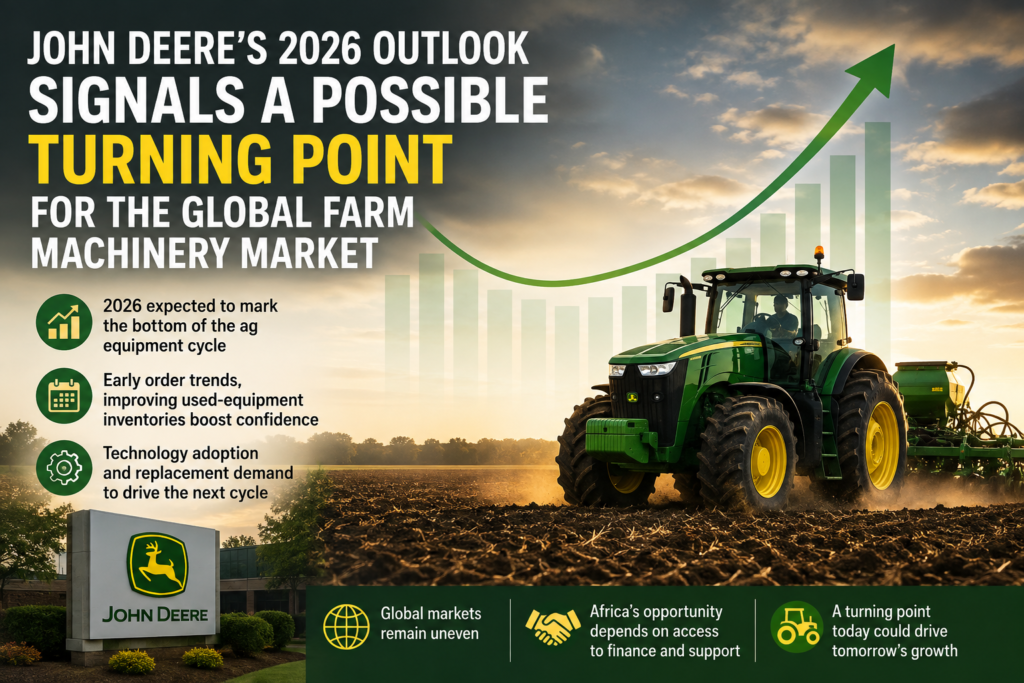
John Deere Q2 2026: Large Ag Still in the Trough — But S7 Combine, New Tractors, and Africa Strategy Signal the Road Ahead


MOLINE, ILLINOIS / BOTHAVILLE, SOUTH AFRICA  |  22 MAY 2026:Deere & Company’s Q2 2026 results confirm what African grain producers and equipment dealers already know on the ground: large-scale agriculture is deep in a difficult cycle.

But the company’s product launches at Nampo 2026, its Africa mechanisation strategy, and its own guidance point firmly toward recovery — and a wave of next-generation machinery coming to market from August.

The Broader Picture: Where Deere’s Ag Business Stands

Deere & Company reported net income of $1.773 billion for Q2 FY2026, or $6.55 per diluted share — ahead of analyst expectations of around $5.70 to $5.87.

Total worldwide net sales rose 5% year-on-year to $13.37 billion for the quarter. But behind the headline beat lies a sharply divergent story across Deere’s three operating segments, with the agricultural equipment divisions pulling in opposite directions.

CEO John May was direct: fiscal 2026 is the bottom of the current agricultural cycle. Large-scale farm equipment is under sustained pressure from a combination of weak farm income, elevated input costs, high interest rates, and trade-related uncertainty.

Yet Deere is holding double-digit operating margins across all segments — a signal that structural discipline is intact even as volumes compress.

“We are delivering double-digit margins across all segments and expect to grow our top line by more than 5% this year — even as large ag operates below trough levels.” — John May, CEO, Deere & Company


Segment Breakdown: Production Ag Down 14%, Small Ag Up 16%

The contrast between Deere’s two agricultural segments could hardly be more pronounced this quarter.

Production and Precision Agriculture — the heartland of large combine harvesters, row crop tractors, and precision planting systems — saw net sales fall 14% year-on-year to $4.50 billion, with operating profit plunging 39% to $706 million as lower shipment volumes collided with rising production costs.

Small Agriculture and Turf, meanwhile, posted a 16% revenue increase to $3.49 billion, with operating profit expanding 25%, as the compact and turf equipment market continues its recovery toward mid-cycle.

Q2 FY2026 — Deere Segment Performance at a Glance

Segment Net Sales Q2 2026 YoY Change Op. Profit Change
Production & Precision Ag $4.50 billion -14% -39% to $706M
Small Ag & Turf $3.49 billion +16% +25%
Construction & Forestry $3.79 billion +29% +48% to $561M

Source: Deere & Company Q2 FY2026 Earnings Release, 21 May 2026

For African farmers and ag equipment stakeholders, the Production & Precision Ag weakness reflects a global trend also visible in South Africa, Kenya, Zimbabwe, and Zambia: declining tractor registrations, cautious dealer inventories, and extended replacement cycles as producers manage cash flow carefully.

The Small Ag recovery, however, points to a sub-segment that is closer to African smallholder and mid-scale farming realities — a market Deere is actively targeting through its Africa mechanisation partnerships.

The Agricultural Cycle: Bottom in 2026, Recovery Expected in 2027

Management maintained its view — and full-year net income guidance of $4.50 billion to $5.0 billion — on the basis that 2026 is the trough of the current multi-year farm equipment cycle.

Revenue in the second half of FY2026 is expected to be slightly higher than the first, with Q4 projected to be the strongest quarter, partly due to the timing of large tractor deliveries.

For African farmers considering whether now is the time to invest in new equipment, the cyclical context matters.

Historically, equipment cycle troughs coincide with improved dealer flexibility on pricing and financing terms, as manufacturers and their distribution networks work to move inventory and maintain customer relationships through the downturn.

Large tractor and combine buyers — particularly commercial grain farms in South Africa’s Highveld and Western Cape — may find more negotiating room in 2026 than in the peak years of 2021 to 2023.

FY2026 Full-Year Agricultural Guidance

Item Guidance / Status
Full-Year Net Income Guidance $4.5 – $5.0 billion
Large Ag Cycle Status Below trough — recovery from 2027
Small Ag & Turf Cycle Status Progressing toward mid-cycle
H2 FY2026 Revenue Trajectory Slightly higher than H1
Q4 FY2026 Outlook Strongest quarter of FY2026
Price Realisation (full year) +2.5 percentage points
Currency Translation (full year) +~2 percentage points

Source: Deere & Company Q2 FY2026 Earnings Call, 21 May 2026

What’s New from John Deere at Nampo 2026: S7 Combine and 540-Series Tractors

Even as the financial results reflect the depth of the ag downcycle, John Deere’s product team was making headlines at Nampo Harvest Day in Bothaville, South Africa — the Southern Hemisphere’s largest agricultural equipment show.

The 59th edition drew 81,822 visitors over four days, setting a new single-day attendance record of 24,579 and narrowly missing the all-time show record.

John Deere S7 Combine Harvester

John Deere introduced the S7 combine harvester at Nampo 2026 — an upgrade designed to deliver greater throughput efficiency, smarter crop processing, and improved integration with the John Deere Operations Center digital ecosystem.

The S7 competes directly with the New Holland CR10 and Case IH Axial-Flow 9, both of which also featured at the show. All three machines are expected to reach southern African dealers from August 2026 onwards.

For commercial grain producers in South Africa’s maize, wheat, and sorghum belts — particularly in the Free State, North West, and Mpumalanga — the S7 arrives at a moment when many farms are managing aging combine fleets and looking ahead to the recovery cycle for major capital investment.

The combination of a trough market and new product availability may make 2026 a strategically attractive entry point.

540-Series High-Horsepower Rigid-Frame Tractors with eAutoPowr EVT

John Deere’s other flagship Nampo announcement was the 540-series rigid-frame tractor range — the most powerful production tractors the company has offered in Africa.

Powered by the 13.6-litre JD14 engine and equipped with the eAutoPowr Electric Variable Transmission (EVT) — described as the first electro-mechanical split-path transmission in commercial agriculture — the flagship 540 models produce 594hp (437kW) as standard.

Intelligent Power Management (IPM) boosts output on demand to 634hp (466kW) when conditions require it: heavy draft, slopes, or difficult field conditions.

Hein Snyman, John Deere’s regional production system specialist for Africa and the Middle East, confirmed the company spent six to seven years developing this powertrain specifically around customer needs in its key markets.

The 540-series delivers up to 634hp on demand via the eAutoPowr EVT — six to seven years in development, now available to African commercial producers from August 2026.


The eAutoPowr transmission is particularly significant for large-scale African farming operations running extended shifts in variable field conditions.

The split-path architecture combines the efficiency of a mechanical drive with the smoothness of a hydrostatic transmission — reducing fuel consumption and operator fatigue over long operating days, while maintaining full power delivery under load.

John Deere’s Africa Strategy: Mechanisation, Digital, and Hello Tractor

Deere’s Africa footprint extends well beyond the premium equipment segment showcased at Nampo.

The company holds market leadership across the African agricultural tractor market, where five major manufacturers — Deere, AGCO, CNH Industrial, Mahindra, and Kubota — collectively account for 76% of market revenue.

The Middle East and Africa farm equipment market was valued at $16.8 billion in 2025 and is projected to grow at a compound annual rate of 5.6% through 2035, according to Global Market Insights.

South Africa’s agricultural machinery market alone is forecast to reach $1.21 billion by 2030, growing at 5.9% per year from a $910 million base in 2025.

A significant element of Deere’s Africa growth strategy targets smallholder and mid-scale farmers — the backbone of food production across Kenya, Ghana, Tanzania, Nigeria, and Zambia.

The company has made a minority investment in Hello Tractor, a Nigerian-founded tractor-sharing and fleet management platform that connects smallholder farmers with tractor service providers via a mobile application.

Hello Tractor and John Deere received $4.5 million in philanthropic funding from Heifer International to expand their equipment leasing and access programs across sub-Saharan Africa.

John Deere’s director of Ag and Turf Sales and Marketing for Africa and Asia confirmed that the Hello Tractor partnership aligns with the company’s ‘Leaps Ambition’ — a target to enable 100% connectivity of small ag equipment by 2026.

Deere’s competitive advantage in Africa increasingly stems from its precision software ecosystems that generate recurring subscription revenue, rather than hardware alone — a model well suited to large commercial farming estates in South Africa, Zimbabwe, and Zambia, as well as to the growing agribusiness sector in East Africa.

Market context: The Africa agricultural tractor market is moderately consolidated, with John Deere maintaining leadership. The South Africa agricultural machinery market is projected to grow from $910 million (2025) to $1.21 billion by 2030 at 5.9% CAGR. The broader Middle East and Africa farm equipment market is forecast to reach USD 16.8 billion CAGR 5.6% through 2035.


What the Q2 Results Mean for African Ag Equipment Buyers and Dealers

  • The cycle trough creates purchasing opportunity: Management confirms 2026 is the bottom of the large-ag equipment cycle. For farms planning a major capital refresh — combines, large tractors, precision planting systems — negotiating conditions with dealers are likely to be more favourable in 2026 than they will be once the recovery gains momentum in 2027.
  • S7 combine and 540-series tractors available from August: Both machines showcased at Nampo 2026 will be available from August onwards. Farms with harvest or heavy-draft requirements in the upcoming southern hemisphere summer season should confirm order timelines with their John Deere dealer now.
  • Financing terms may be softening: Deere Financial’s global net income was $190 million for Q2 — a stable business that underpins the company’s capacity to offer competitive financing packages in Africa through its dealer network and local banking partnerships. Monitor dealer promotions ahead of the August launch window.
  • Precision agriculture adoption is the long-term play: John Deere’s recurring software revenue model — Operations Center, JDLink telematics, and AutoTrac guidance — is increasingly available on mid-range as well as premium equipment. African farming operations that adopt these tools now will benefit from data continuity and machine learning optimisation as the product ecosystem matures.
  • Smallholder access expanding via Hello Tractor: Farmers and cooperatives in Kenya, Ghana, Tanzania, Nigeria, and Zambia without the capital for equipment ownership can increasingly access John Deere-backed machinery through the Hello Tractor platform — a viable path to mechanisation for mid-scale producers in sub-Saharan Africa.


EDITORIAL METADATA

Meta Description John Deere Q2 2026 earnings: large ag down 14% as cycle hits bottom, but S7 combine and 634hp tractors debut at Nampo 2026 — plus Deere’s Africa mechanisation strategy explained.
Focus Keyphrase John Deere Q2 2026 agriculture Africa Nampo S7 combine tractor
Tags John Deere, AgriMachinery, Nampo 2026, S7 Combine, 540-Series Tractor, eAutoPowr, Africa Agriculture, Farm Equipment, Hello Tractor, Ag Cycle
Category OEM News / Earnings / Africa Market
Canva Image Prompt John Deere S7 combine harvester cutting through golden maize field at sunrise, South African highveld landscape, wide editorial photography style
Suggested Slug john-deere-q2-2026-agriculture-africa-nampo-s7-combine-540-tractor
Sister Publication Cross-link to CCE News John Deere construction segment article


Also Read

Mahindra Cuts Ties with Mitsubishi — Then Bets Big on North America

U.S. Tractor Sales Fall 12% in February as Farmers Tighten Belts, AEM Data Shows

NAMPO 2026: Foot-and-Mouth Disease Forces Historic Livestock Ban


Special Coverage

Animal Health

NAMPO Harvest Day 2026

NAMPO Park, Bothaville, South Africa, 14 May 2026: Walk the livestock arena at NAMPO Park this week and you will notice something missing.

The familiar sounds and smells of South Africa’s prize cattle, sheep breeds, and pigs — a fixture of every NAMPO Harvest Day since 1967 — are absent.

In their place: horses, poultry, breed displays without animals, and educational exhibits. The reason is not a logistical choice. It is a disease emergency.

Grain SA and NAMPO management took the decision earlier this year to ban all cloven-hoofed animals from NAMPO 2026 — cattle, sheep, goats, and pigs — citing the ongoing foot-and-mouth disease (FMD) outbreak that has spread to all nine South African provinces and been declared a national disaster by President Cyril Ramaphosa.

It is the first time in the show’s 59-year history that livestock of this kind have been excluded.

The decision speaks to the severity of what South Africa is facing: not a routine FMD flare-up, but what veterinary officials and industry bodies are describing as the worst outbreak in the country’s recorded history.

NAMPO 2026 Update

FMD at NAMPO 2026 — The Decision at a Glance

Decision
All cloven-hoofed animals (cattle, sheep, goats, pigs) excluded from NAMPO 2026.
Reason
Active national Foot-and-Mouth Disease (FMD) outbreak declared a national disaster by President Ramaphosa.
Historical Significance
First exclusion of livestock in NAMPO’s 59-year history since its establishment in 1967.
Arena Alternatives
Horses, poultry, breed displays, educational exhibits, and strongman competitions remain part of the program.
Biosecurity Basis
FMD can spread through direct animal contact as well as contaminated vehicles, clothing, and equipment.


The Outbreak: Scale, Spread, and a National Disaster Declaration

South Africa’s current FMD crisis has roots going back to 2019, when the country lost its OIE (World Organisation for Animal Health) FMD-free status following an outbreak linked to buffalo in Kruger National Park — Africa’s only known natural wildlife reservoir for the virus.

But the scale of what has unfolded since mid-2024, and particularly from late 2025 into 2026, represents an entirely different order of magnitude.

By January 2026, the disease had spread to seven of South Africa’s nine provinces: KwaZulu-Natal, Mpumalanga, Gauteng, North West, Limpopo, Free State, and Western Cape.

KwaZulu-Natal has been the most severely affected, designated a Disease Management Area, with 187 unresolved cases out of 207 reported since the crisis began.

The disease has moved from communal farms and informal livestock auctions — where inadequate biosecurity allowed rapid spread — into commercial beef feedlots, dairy operations, and game reserves where buffalo populations serve as long-term carriers.

President Ramaphosa referenced the crisis in his 2026 State of the Nation Address, and in early 2026 the government formally declared FMD a national disaster.

Agriculture Minister John Steenhuisen confirmed the government would cover the full cost of vaccinating the national herd — a commitment that reflects both the political urgency and the enormous scale of the response required.

We have seen the pain, the uncertainty and the economic damage this disease has inflicted on farming communities across our country. I have made a commitment that if we continue implementing this plan at scale and with urgency, this must be the last major Foot and Mouth Disease outbreak to devastate our people.

— Minister John Steenhuisen
South African Agriculture Minister


The Vaccination War: 15 Million Doses and a December Target

The government’s response has been an unprecedented national vaccination campaign, the ambition of which reflects the scale of the emergency.

The target: vaccinate 80% of South Africa’s national cattle herd — approximately 14 million animals — by December 2026. It is the most ambitious animal health intervention in South African history.

Vaccine procurement has been pursued internationally at scale. South Africa received one million doses from Biogénesis Bagó in Argentina — the same company exhibiting at NAMPO this week as part of the Brazilian/Argentine agribusiness delegation — and 1.5 million doses from Dollvet in Turkey in the early stages of the campaign.

A further two million Dollvet doses arrived in early May 2026. With an additional five million doses expected shortly, Minister Steenhuisen confirmed South Africa’s total imported vaccine volume will rise to 13 million doses.

Combined with two million doses secured earlier from the Botswana Vaccine Institute, the country is projected to have 15 million doses by end of May 2026.

Hundreds of thousands of animals are being vaccinated each week across all provinces.

The government is pursuing a vaccination-to-live strategy rather than the stamp-out culling approach used in countries like the United States and Western Europe.

he distinction matters commercially: vaccination-to-live aims to achieve ‘FMD free with vaccination’ status under international trade rules — a designation that still allows exports but carries more trade conditions than full FMD-free status.


National Response Plan

South Africa’s Vaccination Campaign — Key Facts

Target
80% of the national cattle herd vaccinated by December 2026 — approximately 14 million animals.
Strategy
Vaccination-to-live approach instead of mass stamp-out culling.
Goal
Achieve “FMD free with vaccination” status under OIE/WOAH regulations.
Vaccine Doses Secured
15 million doses by end-May 2026 — including 13 million imported doses and 2 million from Botswana Vaccine Institute.
Suppliers
Biogénesis Bagó (Argentina), Dollvet (Turkey), and Botswana Vaccine Institute.
Government Commitment
Full vaccination costs covered by the state at no charge to farmers.
Regional Coordination
SADC agriculture ministers meeting chaired by Minister Steenhuisen in Zimbabwe.


On 11 May — just one day before NAMPO opened — Minister Steenhuisen joined Eswatini’s Agriculture Minister Mandla Tshawuka and Mozambican representatives in Hazyview, Mpumalanga, where 300 cattle were vaccinated in a demonstration of regional solidarity.

A SADC agriculture ministers’ meeting focused on regional livestock traceability and coordinated transboundary disease response is scheduled to follow later this month in Zimbabwe — a signal that South Africa recognises FMD cannot be contained within its borders alone.

The Economic Damage: China, Zambia, and Billions in Lost Exports

The commercial consequences of South Africa’s FMD crisis have been severe and are compounding.

The livestock and red meat sector — beef and dairy together contributing an estimated R68 billion in annual gross production value — has been hit by a cascade of export market closures that directly reflect the disease’s spread.

China, South Africa’s largest trading partner and its most important beef export destination, suspended all beef and related product imports following confirmation that FMD had spread beyond KwaZulu-Natal into Mpumalanga and Gauteng.

The ban came despite a Memorandum of Understanding signed between South Africa and China in September 2024, which had been specifically designed to allow exports from FMD-free provinces to continue during localised outbreaks.

The virus outpaced the regionalisation framework before it could be practically implemented.

This development is a stark reminder of the fragility of our export markets when faced with biosecurity threats. The economic impact on South African farmers and the entire red meat value chain is severe and disheartening.

— Dewald Olivier
CEO, Red Meat Industry Services (RMIS)


Zambia followed in February 2026, suspending all import permits for South African livestock and related products with immediate effect and no declared end date.

The ban covers live cloven-hoofed animals, skins, hides, feed, and dairy products unless strict biosecurity conditions are met.

Botswana, Zimbabwe, and Mozambique have all previously suspended imports during earlier outbreak phases.

The financial toll is now quantified. Beef export volumes fell from a record 39,700 tonnes in 2024 to 29,500 tonnes in 2025, with projections suggesting a further decline to approximately 13,400 tonnes in 2026 if current conditions persist.

Across three major FMD waves between 2019 and 2025, beef export revenue losses are estimated at more than R821 million.

At the current trajectory, cumulative losses could reach R2.6 billion by end of 2026. Under a sustained high-burden scenario extending to 2030, the Bureau for Food and Agricultural Policy (BFAP) projects beef gross production value losses of up to R11.3 billion.

The dairy sector has felt the impact in a different but equally painful way. More than 90 dairy farms reported FMD outbreaks between January 2024 and January 2026, with over 210,000 dairy cattle affected.

Cumulative dairy losses to date are estimated at approximately R1 billion, with per-cow losses averaging around R5,000 driven by reduced milk production, higher veterinary intervention costs, and management disruption.

BFAP has warned that prolonged disease pressure could push some family-owned dairy operations beyond financial recovery.

Economic Impact Snapshot

Beef & Dairy Trade Disruption — Key Data

Beef exports (2024)
39,700 tonnes (record high)
Beef exports (2025)
29,500 tonnes (-26%)
Projected exports (2026)
~13,400 tonnes if current conditions persist
Export losses (2019–2025)
R821 million (estimated across three FMD waves)
Projected cumulative (2026)
Up to R2.6 billion in losses
2030 high-burden scenario
Up to R11.3 billion GPV loss (BFAP estimate)
Dairy impact
210,000+ dairy cattle affected (Jan 2024 – Jan 2026)
Dairy losses
~R1 billion (BFAP / MPO data)
Trade restrictions
China beef ban suspended (regionalisation MoU ineffective); Zambia livestock ban effective from 14 Feb 2026 (open-ended).


How FMD Spreads — and Why Equipment Matters

Foot-and-mouth disease is caused by an RNA virus of the Picornaviridae family and is among the most contagious pathogens known in veterinary medicine.

It infects all cloven-hoofed animals — cattle, sheep, goats, pigs, buffalo, and many wildlife species — through direct contact with infected animals, aerosol transmission, and critically for the agricultural machinery sector, through contaminated equipment, vehicles, clothing, and footwear.

This last transmission pathway is directly relevant to AgriMachinery.Africa readers. Farm vehicles, livestock transport trucks, loading ramps, handling equipment, and any machinery moving between properties can carry and spread FMD virus on contaminated surfaces.

The virus is robust: it can survive for weeks in the environment depending on temperature and pH conditions, and can be carried on tyres, wheel arches, chassis undercarriages, and cab interiors.

The South African outbreak has demonstrated how easily the disease travels through interconnected commercial supply chains.

Spread traced to informal livestock auctions, movements between holding stations, and transport to feedlots — all involving vehicles and handling equipment — has been a consistent feature of confirmed outbreak clusters.

Karan Beef’s Heidelberg feedlot outbreak in Gauteng in mid-2025, for example, was traced to cattle transported from an auction in Heidelberg, with subsequent spread to adjacent feedlot camps.


Biosecurity Protocols

FMD Biosecurity for Farm Equipment — Key Protocols

Vehicle washdown
All farm vehicles entering/exiting affected zones must be thoroughly washed and disinfected — tyres, wheel arches, chassis, and cab floors.
Disinfectant
Sodium carbonate (washing soda, 4%), citric acid solution, or approved veterinary disinfectants effective against FMD virus.
Footwear
Rubber boots must be disinfected at every farm entry/exit point using footbaths with approved disinfectant.
Clothing
Outer garments worn in livestock areas must be changed or disinfected before moving between properties.
Livestock transport vehicles
Must be cleaned and disinfected after every load, including drainage points and internal surfaces.
Movement permits
Required under South Africa’s Animal Diseases Act for livestock movement in affected zones; vehicles carrying livestock must comply.
Reporting obligation
Farmers are legally required to report suspected FMD symptoms to the nearest state veterinarian.

The decision to exclude cloven-hoofed animals from NAMPO 2026 is itself a biosecurity measure of the highest order.

Concentrating tens of thousands of animals from across South Africa in one location during an active national outbreak would create conditions for accelerated viral spread on a scale that could be catastrophic.

The show organisers made the correct call — but the very fact that this call was necessary tells the story of how serious South Africa’s situation is.

The Regional Picture: Zimbabwe, Botswana, and the Cross-Border Risk

South Africa’s FMD crisis does not exist in isolation.

The disease is spreading across the Southern African Development Community region in a pattern that reflects the biological reality that viruses recognise no national border.

In Zimbabwe, veterinary authorities have confirmed active FMD outbreaks in Matabeleland South Province, close to the Botswana border — an area where communal grazing systems and informal cross-border livestock trade create ideal transmission conditions.

Botswana has confirmed infections in its northeastern Masunga district, triggering quarantine measures and livestock movement controls.

Botswana, whose economy depends heavily on premium beef export markets, is moving urgently to contain the outbreak before it threatens its trading reputation.

For East Africa, the risk is longer-range but real. Kenya, Tanzania, Uganda, and Ethiopia all carry endemic FMD in their livestock populations to varying degrees, and each shares porous borders where informal cattle and livestock trade is routine.

The biosecurity lesson from South Africa’s 2025-2026 experience — that commercial supply chains, livestock auctions, and transport networks are primary amplification mechanisms — applies with equal force to East African cattle corridors.

Minister Steenhuisen’s upcoming SADC agriculture ministers’ meeting in Zimbabwe, focused on establishing a regional platform for animal movement control and livestock traceability, is a recognition that disease management at this scale requires continental coordination.

It is also an acknowledgement that South Africa’s outbreak, however severe domestically, is the region’s problem collectively.

What NAMPO’s Empty Livestock Arena Signals for African Agriculture

The sight of NAMPO’s livestock arena running without its traditional cattle and sheep breeds is, in its own way, one of the most powerful agricultural policy signals in Africa this year. NAMPO is not a minor provincial show.

It is the largest privately-owned agricultural exhibition in the Southern Hemisphere, a gathering that for nearly six decades has been the continent’s most important platform for livestock genetics, breed performance, and animal health knowledge exchange.

Its empty animal pens in 2026 are a visible reminder that biosecurity — long treated as a background operational concern for most farming businesses — has become a front-and-centre strategic issue for African agriculture.

The economic stakes demonstrated by South Africa’s experience are not abstract: R821 million in confirmed export losses, a 26% decline in beef export volumes, the loss of the Chinese market, and the prospect of R11.3 billion in cumulative production value destruction under a sustained high-burden scenario.

For machinery and equipment operators across Africa, the FMD crisis has a direct practical message: biosecurity protocols for vehicles, handling equipment, and transport infrastructure are no longer optional considerations.

They are commercially essential — and in South Africa, legally required.

The equipment industry has a role to play in this response, from washdown facility design and disinfection station manufacturing to GPS-enabled livestock traceability systems that allow outbreak clusters to be traced and contained before they reach the scale of what South Africa is now managing.

Key Takeaways

FMD & Agricultural Impact — Key Insights

Transmission Risk
FMD spreads via equipment surfaces — vehicles, handling gear, tyres, and footwear — not only direct animal contact.
Economic Impact
South Africa has lost over R821 million in exports since 2019; worst-case projections estimate up to R11.3 billion by 2030.
NAMPO Significance
The livestock ban is the strongest visible indicator of a national disaster-level animal disease response.
Regional Spread
Confirmed cases in Zimbabwe and Botswana; East African corridors remain high-risk endemic zones.
Vaccination Drive
15 million doses targeted by May 2026 and 14 million cattle to be vaccinated by December 2026.
Regional Coordination
SADC traceability and movement control platform under development, with Zimbabwe-hosted ministerial meeting imminent.
Industry Opportunity
Growing demand for washdown stations, disinfection systems, and GPS-based livestock traceability solutions.


Outlook

NAMPO 2026 closes on Friday 15 May. The livestock ban will be lifted in future editions if South Africa can achieve and sustain its vaccination targets and regain FMD-free with vaccination status under international trade rules.

That process is expected to take years, not months.

The vaccination-to-live strategy requires consistent coverage, rigorous traceability, and sustained inter-provincial biosecurity enforcement — all of which have historically proved difficult to maintain across South Africa’s complex mix of commercial and communal farming systems.

What is certain is that the landscape of African livestock farming has shifted. The question of how farm businesses, transport operators, equipment suppliers, and governments manage biosecurity at the intersection of animal health and agricultural commerce is no longer theoretical.

South Africa’s 2025-2026 FMD crisis has made it one of the defining agricultural risk issues on the continent. NAMPO’s empty animal pens are the most emphatic possible illustration of what is at stake.

Also Read

NAMPO 2026: New Holland CR10 and Scania Super Steal the Show as Machinery Giants Race to Prove ROI

NAMPO 2026: Brazil Targets African Farm Markets with $1.65bn Machinery Export Push

NAMPO 2026: Brazil Targets African Farm Markets with $1.65bn Machinery Export Push


When Brazil’s agricultural machinery industry descends on Bothaville each May, it arrives not merely as an exhibitor but as a strategic mission.

This year is no different. At NAMPO Harvest Day 2026, a delegation of eleven Brazilian manufacturers is on the ground at NAMPO Park — backed by the full weight of Brazil’s government-industry export promotion machinery — with one clear brief: turn Africa’s growing appetite for farm mechanisation into signed contracts.

The timing is deliberate. Brazilian agricultural machinery exports grew 11.9% in 2025, reaching USD 1.65 billion — a figure that reflects the confidence of an industry which has spent decades engineering equipment for the demanding tropical and subtropical conditions that characterise much of the African continent.

South Africa’s NAMPO, the southern hemisphere’s largest agricultural exhibition, is the continent’s most efficient gateway for making those connections happen.


Brazil at NAMPO 2026 — The Numbers

Delegation size: 11 manufacturers (Brazil Machinery Solutions programme)

2025 export growth: +11.9% year-on-year

2025 total agri-machinery exports: USD 1.65 billion

NAMPO 2025 business generated: USD 5.9 million (completed + projected, 12-month horizon)

Year-on-year improvement at NAMPO: +56% over 2024 edition

Programme backing: ABIMAQ + ApexBrasil (Brazil Machinery Solutions)


Who Is in Bothaville — and What They Are Selling

The eleven companies participating under the Brazil Machinery Solutions programme represent a broad cross-section of Brazilian agricultural technology.

Magno Jet, Irrigabrasil, SaveFarm, INRODA, Marispan, J. Assy, Ebara, Rugeri Mec-Rul, Indutar, Planti Center, and Implemaster are presenting solutions that span the full crop production cycle — from soil preparation through planting, crop protection, and harvest logistics.

The product portfolio on the stands covers planters and seeders engineered for direct sowing systems, corn headers, grain carts, soil preparation implements, irrigation solutions, spraying technologies, and operator cabin systems.

This range is deliberately comprehensive: the Brazilian delegation is not targeting a single segment but rather positioning itself as a supplier capable of supporting African farming operations at multiple stages of mechanisation maturity — from entry-level first-time mechanisation to more sophisticated precision farming investments.

Direct sowing technology is a particular area of Brazilian expertise that translates well to Southern and East African conditions.

South Africa has seen rapidly growing adoption of no-till and conservation agriculture practices, and Brazilian planters and seeders — engineered for the same high-volume soybean and maize production systems that dominate Brazil’s Cerrado — are well matched to the large-scale grain farming operations of South Africa’s Free State and the emerging mechanisation needs of Zimbabwe, Zambia, and Tanzania.


Magno Jet Spray nozzle technology and precision application systems
Irrigabrasil Irrigation solutions for field crops and horticulture
SaveFarm Agri-tech and farm management solutions
INRODA Agricultural implements and soil preparation equipment
Marispan Planters, seeders, and direct sowing equipment
J. Assy Agricultural implements
Ebara Pumps and water management systems
Rugeri / Mec-Rul Agricultural machinery and implements
Indutar Grain carts and bulk handling equipment
Planti Center Planting systems and precision agriculture
Implemaster Agricultural implements and corn headers


The Business Model Behind the Delegation

Brazil’s presence at NAMPO is not improvised. It is structured through Brazil Machinery Solutions — a coordinated export promotion programme run jointly by ABIMAQ (the Brazilian Machinery Builders’ Association) and ApexBrasil, Brazil’s trade and investment promotion agency.

The programme’s model is specifically designed to convert trade fair attendance into measurable commercial outcomes rather than brand visibility alone.

Central to this approach at NAMPO 2026 is a business matchmaking agenda: structured meetings between the Brazilian manufacturers and pre-identified importers, distributors, and agribusiness buyers from across Southern Africa.

This is not a passive exhibition strategy. The delegation arrives in Bothaville with appointment books, commercial targets, and follow-up frameworks already in place.


“The international scenario requires more strategic decisions and the search for markets with consistent growth potential. NAMPO facilitates direct contact with regional partners and expands the reach of Brazilian companies across the continent.”

— Rayane Alvarenga, Executive Manager of International Market Commercial Promotion, ABIMAQ


The track record justifies the investment. At NAMPO 2025, the Brazilian delegation generated USD 5.9 million in completed and projected business over the following twelve months — a result 56% higher than the previous year’s edition.

Going further back, NAMPO 2023 generated USD 8 million in closed and forecast deals from a delegation of thirteen companies, with 96 business meetings held against an initial expectation of 40 — a 140% overrun on contact volume that ABIMAQ described at the time as exceeding all expectations.

The compound effect of repeated participation is a key element of the strategy. Each NAMPO edition builds on the distributor relationships and market intelligence gathered in previous years, creating a cumulative commercial footprint that single-appearance exhibitors cannot replicate.

Why Africa, and Why Now

The strategic logic behind Brazil’s escalating African push is grounded in structural parallels that few other machinery-exporting nations can claim.

Brazil and sub-Saharan Africa share broadly similar agro-climatic conditions: tropical and subtropical temperatures, variable rainfall, red laterite soils, and primary crop portfolios — maize, soybeans, sorghum, sunflower — that overlap significantly.

Brazilian machinery has been engineered and field-tested in these conditions over decades. German or North American equipment, by contrast, was designed primarily for temperate continental climates and often requires adaptation for African operating environments.

Africa’s mechanisation deficit also creates a demand dynamic unlike any other major market. Sub-Saharan Africa remains one of the most under-mechanised farming regions in the world.

Tractor density across much of the continent stands at fewer than five units per 1,000 hectares of arable land — compared to over 200 in Brazil and more than 300 in Western Europe.

Even modest increases in mechanisation penetration represent enormous absolute market volume given the scale of African agriculture.


African Markets in the Brazilian Crosshairs

South Africa — Primary entry market; established distributor networks; large-scale grain and livestock production

Zimbabwe — Growing maize and tobacco mechanisation demand; recovering commercial farming sector

Tanzania — Rapidly expanding rice, maize, and sunflower production; government mechanisation drives

Angola — Post-conflict agricultural recovery; strong Brazilian-Portuguese commercial ties

Mozambique — Emerging large-scale farming corridor; Nacala corridor development creating demand

Zambia — Copper belt and commercial farming corridor; growing cooperative sector mechanisation


NAMPO’s geographic positioning makes it the ideal commercial bridge. Bothaville draws buyers and distributors not just from South Africa but from Zimbabwe, Mozambique, Zambia, Tanzania, and Angola — making it possible for a Brazilian manufacturer to hold commercial meetings with potential partners from six countries in four days, at a cost and logistical complexity that individual market visits could not match.

The Argentine machinery industry is making the same calculation. At NAMPO 2026, Argentine companies including Apache — presenting its 27000+ and 99000 planter ranges — are also targeting South Africa’s direct sowing market, which covers an estimated 4.5 million productive hectares with maize comprising roughly 60% of the cultivated area. The competition for African agri-machinery distribution channels is intensifying, and Brazil is competing with a home-field advantage in climate-adapted technology.

The Kenya and East Africa Angle

For readers and operators in East Africa, the implications of Brazil’s NAMPO push reach beyond South Africa’s grain belt.

Kenya’s large-scale grain production in the North Rift — Trans Nzoia, Uasin Gishu, Elgeyo Marakwet — operates on farm sizes and in climate conditions directly comparable to parts of Brazil’s southern producing states.

The direct sowing planters, grain carts, and precision spraying systems on the Brazilian stands at NAMPO are not theoretical products for this market; they are functionally applicable to it.

The more immediate near-term pathway is through the distribution networks that Brazilian manufacturers are building in South Africa.

Several Brazilian brands that entered the Southern African market through NAMPO in previous years have subsequently extended distribution arrangements northward into East Africa.

As distributor relationships consolidate in Bothaville this week, some of those agreements will include territory clauses that cover Kenya, Tanzania, and Uganda.

East African agricultural policymakers and cooperative farming organisations tracking equipment sourcing options should be watching the Brazil-Africa agricultural machinery corridor closely.

Brazil’s combination of climate-adapted technology, government-backed export financing support, and competitive pricing relative to European equivalents makes it an increasingly serious alternative source for the mechanisation investments that will define African farming productivity over the next decade.


NAMPO 2026 — Brazil at a Glance

Programme: Brazil Machinery Solutions (ABIMAQ + ApexBrasil)

Companies at NAMPO 2026: 11 manufacturers

Products: Planters, seeders, corn headers, grain carts, irrigation, sprayers, implements

Target markets: South Africa, Zimbabwe, Mozambique, Angola, Tanzania, Zambia

Format: Exhibition stands + structured business matchmaking with regional distributors

2025 export total (all agri-machinery): USD 1.65 billion (+11.9% year-on-year)


Outlook

NAMPO runs through Friday 15 May. The Brazilian delegation’s structured matchmaking programme continues through the final day, with follow-up commercial engagement expected to extend well beyond the showgrounds.

ABIMAQ’s track record suggests the 2026 cohort will close this edition with a business pipeline that significantly exceeds the headline exhibit cost — making NAMPO not merely an awareness exercise but a measurable return-on-investment event for Brazil’s agricultural machinery export sector.

For the African farming industry, the Brazilian presence at NAMPO 2026 is a signal worth reading carefully.

It reflects the assessment of one of the world’s most commercially sophisticated agricultural machinery industries that the African market has crossed a threshold of scale and commercial seriousness that warrants structured, persistent investment.

That is a different kind of endorsement from any press release.

Also Read

NAMPO 2026: New Holland CR10 and Scania Super Steal the Show as Machinery Giants Race to Prove ROI

NAMPO 2026 kicks off Tomorrow but Cloven-Hoofed Animals are Banned

NAMPO 2026: New Holland CR10 and Scania Super Steal the Show as Machinery Giants Race to Prove ROI


With over 910 exhibitors and more than 4,000 products on display across NAMPO Park this week, the pressure is always on for machinery brands to cut through the noise.

This year, two standouts have dominated the conversation on the exhibition floor: New Holland’s next-generation CR10 combine harvester, making its Southern Hemisphere stage debut, and the Scania Super — a heavy-duty transport powertrain officially unveiled on Wednesday that is reshaping how the agricultural logistics sector thinks about fuel costs.

Both machines arrive at a moment when African farmers and agribusinesses are squeezing every rand, shilling, and kwacha from their operations. NAMPO 2026’s theme — Resilience through Innovation — was not chosen lightly.

Against a backdrop of rising input costs, constrained margins, and logistical bottlenecks from Bothaville to Nairobi, the question driving every handshake on the showgrounds is simple: does this machine pay for itself faster than the last one? On current evidence, these two answers — one in the field, one on the road — are hard to ignore.


In 2026, the focus at NAMPO is squarely on Resilience through Innovation — helping producers and farmers navigate a complex economic and climatic landscape.

DS
Dr Dirk Strydom
Managing Director, NAMPO

New Holland CR10: 50 Years of Twin Rotor Technology, Reimagined

New Holland’s stand A2/A3 is drawing some of the longest queues on the grounds, and the centrepiece is a machine that has been half a century in the making.

The CR10 is the latest evolution of New Holland’s Twin Rotor combine technology — a platform the brand introduced to the world in 1975 and which has since become the reference point for virtually every high-capacity combine harvester on the global market.

The numbers command attention. The CR10 is powered by a 12.9-litre FPT Cursor 13 turbocharged six-cylinder engine developing 635 horsepower, fed from a 1,300-litre fuel tank engineered for extended harvesting runs without refuelling stops.

The grain tank holds 16,000 litres and unloads at a rate of 210 litres per second — fast enough that a semi-trailer can be loaded while the machine barely breaks stride across the field.

HIGHLIGHT

New Holland CR10 — Key Specifications at a Glance

Engine
12.9-litre FPT Cursor 13, 635hp
Turbocharged six-cylinder
Fuel Tank
1,300 Litres
Grain Tank
16,000 Litres
Unloading Rate
210 L/sec
Rotor Diameter
24-inch Rotor
Wider & longer threshing compartment
Harvesting Speed
1,900rpm
Reduced noise & fuel consumption
Road Mode Speed
1,300rpm
Maximum travel speed efficiency
Platform
Next Generation CR Series Twin Rotor
Built at Zedelgem, Belgium

What makes the CR10 technically distinctive beyond raw capacity is the redesigned threshing architecture.

The 24-inch rotors sit inside a wider and longer threshing compartment compared to predecessors, creating more crop rotations per pass and driving what New Holland describes as a new generation of grain loss reduction.

The hydraulic system has also been overhauled: all harvest hydraulic drives are mechanically disengaged during road travel via a main engine gearbox clutch, saving up to 20 horsepower and reducing drag.

Load-sensing pumps further cut hydraulic power demands in-field.

For large-scale grain producers across South Africa, Zimbabwe, Zambia, and increasingly East Africa, the CR10 addresses a persistent operational challenge: reducing the number of machine passes required per hectare while protecting grain quality.

The redesigned residue management system and the machine’s intelligent automation package — which recalibrates settings dynamically to adapt to changing crop conditions — are being positioned by New Holland as the answer to the productivity-loss equation that has frustrated producers for years.

“The CR10 is unmatched in its class. Its 24-inch rotors, housed in a wider and longer threshing compartment, feed a 16,000-litre grain tank and unload harvested grain at 210 litres per second.”

Alongside the CR10, New Holland is also presenting the upgraded T9 and Genesis T8 tractor ranges at NAMPO — reinforcing a clear brand message that the company is positioning itself at the large-scale, high-output end of African production agriculture.

The T9 range in particular has gained significant traction in South Africa’s maize belt, where the economics of large-field farming increasingly favour fewer, more powerful machines over larger fleets of mid-horsepower tractors.

Scania Super: The Agri-Logistics Equation Gets a New Variable

If the CR10 is the headline act in the field, the Scania Super is making an equally forceful case for what happens after harvest.

Unveiled at NAMPO Park on Wednesday 13 May, the Scania Super 13-litre powertrain is being positioned as a direct response to one of agricultural Africa’s most stubborn cost pressures: the price of moving bulk grain, fresh produce, and farm inputs across road networks where fuel expenditure can consume between 30 and 50 percent of total transport operating costs.

The engineering proposition is straightforward but significant. Scania’s new 13-litre Super engine achieves up to 50 percent brake thermal efficiency — a figure that represents the proportion of fuel energy converted into useful work, and a benchmark that heavy transport engineers have chased for decades.

The practical result: fuel savings of up to 8 percent against the previous generation Scania powertrain.


HIGHLIGHT

Scania Super 13-Litre — Performance Metrics

Brake Thermal Efficiency
Up to 50%
Industry benchmark figure
Fuel Savings
Up to 8%
vs previous generation
Compatible Fuels
Diesel, HVO, Biodiesel (FAME)
Transmission
Opticruise Automated Gearbox
Optimised for Super platform
Operational Lifespan
Up to 2 million km
25% improvement over predecessor
NAMPO Unveiling
Wednesday, 13 May 2026
NAMPO Park, Bothaville

For fleet operators running grain haulage corridors in South Africa — and increasingly for those operating across the wider SADC region — an 8 percent fuel reduction is not a marginal gain.

On a long-haul heavy-duty truck covering 150,000 kilometres per year, it translates into a material reduction in fuel spend that compounds over the operational life of the vehicle.

Scania South Africa’s Sustainability Manager Mark Templeton was direct about the company’s philosophy at the NAMPO launch: sustainability in transport is not solely a future-state ambition dependent on electric or hydrogen transition, but something achievable today through the efficiency of existing combustion technology.

“Improving efficiency within current fleets is one of the most immediate and scalable ways to reduce environmental impact and lower fuel costs,” Templeton said at the unveiling.

The Scania Super platform is also designed as a coherent powertrain system — engine, gearbox, axles, and control systems engineered together rather than as separate components.

This holistic integration is what enables the efficiency gains, Scania argues, compared with platforms where individual components are upgraded incrementally.

The Super 13-litre is also compatible with HVO and biodiesel, giving operators in markets with improving biofuel infrastructure a pathway toward lower-carbon operations without capital fleet replacement.

“Sustainability in transport is determined by how efficiently goods are moved today, not only by future energy transitions.”

MT
Mark Templeton
Sustainability Manager, Scania South Africa


The Bigger Picture: What These Machines Signal for African Agriculture

The simultaneous prominence of the CR10 and the Scania Super at NAMPO 2026 is not coincidental.

Together, they represent two ends of a supply chain that African agriculture has long struggled to optimise simultaneously — harvesting capacity and post-harvest logistics.

Increasing grain output through high-throughput combine technology only delivers full value if the transport infrastructure exists to move that grain efficiently to storage or export points.

This has historically been one of sub-Saharan Africa’s most persistent agricultural bottlenecks.

South Africa, with its relatively well-developed road freight network and established grain trading infrastructure, is the natural entry point for both technologies on the continent. But the appetite for mechanisation is spreading.

Brazilian machinery exporters — eleven companies of whom are also exhibiting at NAMPO this week — recorded USD 1.65 billion in agricultural machinery exports in 2025, up 11.9 percent year-on-year, specifically targeting African markets including Angola, Mozambique, Tanzania, and Zimbabwe. The global industry is watching this market.

For readers and operators across East Africa, the relevance is direct. Kenya’s large-scale grain production in the Rift Valley, wheat growing in Trans Nzoia, and maize production in the Western counties are all reaching scale thresholds where equipment like the CR10 begins to make economic sense on cooperative or contract farming models.

Meanwhile, transport operators serving port corridors from Mombasa to Kampala, Dar es Salaam to Lusaka, face fuel economics that make the Scania Super’s 8 percent efficiency gain commercially interesting at any route distance.

HIGHLIGHTS

NAMPO 2026 by the Numbers

Event Details
12–15 May 2026 | :contentReference[oaicite:0]{index=0} | Free State, South Africa
Exhibitors
910
Products on Show
4,000+
Theme
Resilience through Innovation
2025 Attendance
87,191
visitors
Notable Update
No cloven-hoofed livestock will be displayed due to FMD biosecurity measures.


Outlook

NAMPO runs through Friday 15 May. Further product announcements and demonstrations are expected on the final day, with precision agriculture technology — including spray drone demonstrations — scheduled for the showgrounds.

AgriMachinery.Africa will continue covering developments from the show floor.

For African farmers and agribusinesses evaluating capital equipment purchases in the 2026 cycle, the CR10 and Scania Super represent a clear direction of travel: higher capacity, lower operating cost per unit of output, and longer service intervals.

In an agricultural economy where margins are under structural pressure, that combination may prove to be the most compelling sales pitch of the year.

Also Read

NAMPO 2026 kicks off Tomorrow but Cloven-Hoofed Animals are Banned

Kenya to Host IUFRO World Congress 2029: A First for Africa


The Rise of Precision Fertilizer Blending in Sustainable Agriculture


For most of modern farming history, fertilizer has been applied with a blunt instrument.

Bags of a standard nitrogen-phosphorus-potassium formulation are spread uniformly across fields, regardless of whether the soil in one corner is already nitrogen-rich or the crop in another zone is entering a critical growth phase.

The result is a system riddled with waste — economically, environmentally, and agronomically. That blunt instrument is now giving way to something far more surgical: precision fertilizer blending.

Precision fertilizer blending is the practice of formulating and applying customised nutrient mixes tailored to the specific requirements of individual soil zones, crops, and growth stages — and then delivering those mixes with variable-rate technology that adjusts application in real time.

It is a convergence of soil science, data analytics, IoT sensing, and equipment engineering, and it is fast becoming one of the defining pillars of sustainable agriculture in the 2020s.

“Precision nutrient strategies have demonstrated the potential to reduce fertilizer waste by up to 30%, delivering measurable gains in both yield and sustainability.”

The Problem with Conventional Fertilization

The scale of fertilizer waste in conventional agriculture is staggering. Research indicates that as much as 50% of applied nitrogen fertilizer exceeds what crops can actually absorb and use.

That surplus nitrogen does not simply disappear.

Soil microbes convert a portion of it into nitrous oxide (N₂O), a greenhouse gas that is 265 times more potent than carbon dioxide over a 100-year period.

The remaining excess leaches into waterways, contributing to algal blooms, dead zones in aquatic ecosystems, and the contamination of drinking water sources.

The climate cost is measurable: agricultural nitrous oxide emissions rose by 40% between 1980 and 2020, largely driven by the expanding use of synthetic nitrogen fertilisers.

Emerging economies across Africa, Asia, and South America are among the largest contributors to this trend, as smallholder and commercial farmers alike ramp up fertilizer use in pursuit of food security.

Yet the paradox is acute — the same practice meant to feed more people is quietly destabilising the climate systems on which food production depends.

Insight: Agricultural soils are responsible for as much as 75% of total U.S. nitrous oxide emissions — a pattern replicated across many high-intensity farming regions globally.

What Precision Blending Actually Involves

Precision fertilizer blending begins with detailed knowledge of the soil. Grid-based soil sampling and on-field sensor networks generate granular data on nutrient levels, pH, organic matter content, moisture, and temperature across different zones within a single field.

IoT-enabled soil sensors can now provide continuous data streams rather than one-off seasonal snapshots, enabling dynamic, responsive nutrient management throughout the growing season.

This data feeds into farm management software platforms that generate prescription maps — field-specific blueprints specifying what nutrient blend should be applied where, and at what rate.

The prescription is then executed through variable rate technology (VRT), which instructs spreaders, planters, and sprayers to adjust their output on the fly as they traverse different soil management zones.

A sandy, potassium-deficient patch in one quadrant receives a different blend from the clay-heavy, phosphorus-saturated section 200 metres away.

On the blending side, fertilizer producers and co-operatives are investing in on-site blending facilities that can formulate customised NPK ratios and micronutrient packages to order, rather than supplying only off-the-shelf grades.

This shift from commodity to customised product is reshaping the fertilizer supply chain, with some agri-input companies now offering digital platforms where farmers can upload soil test results and receive blended product recommendations within hours.

Technology Enablers: Sensors, Drones, and AI

Several converging technologies are accelerating the precision blending revolution. Drone-based remote sensing and hyperspectral imaging now allow large-scale fertility mapping at a fraction of the time and cost of ground-level sampling.

A drone pass over a 500-hectare field can generate nutrient stress maps, chlorophyll index readings, and moisture distribution data that would take a team of agronomists weeks to compile manually.

On-site, portable X-ray fluorescence (XRF) analysers and handheld near-infrared (NIR) spectrometers are becoming standard tools for rapid soil and plant tissue analysis.

These instruments provide lab-grade nutrient readings within minutes, allowing agronomists to make immediate blending adjustments without waiting for laboratory turnaround times.

Machine learning algorithms are increasingly embedded in decision support systems, processing multi-year yield data, weather forecasts, crop phenology models, and real-time sensor inputs to generate optimised fertilization recommendations.

The agricultural variable rate technology market reflects this growing momentum, estimated at USD 4.29 billion in 2024 and projected to reach USD 4.84 billion in 2025 — a trajectory expected to continue as digital agriculture platforms lower the barriers to adoption for farms of all sizes.

Key Stat: IoT-enabled soil sensors with continuous data streams can reduce nutrient waste by over 25% compared to static, one-time soil sampling approaches.

“In a single field, sandy areas might need more potassium while clay-rich zones need extra phosphorus — precision blending addresses each with surgical accuracy.”

Nanotechnology and Smart Fertilizer Formulations

Beyond variable application, innovation is also happening at the formulation level. Nanotechnology is enabling a new generation of controlled-release fertilizers (CRFs) that use polymer coatings, nano-encapsulation, and smart-release triggers to synchronise nutrient availability with plant uptake windows.

These formulations significantly reduce the risk of nutrient leaching and volatilisation, the two primary pathways through which conventional fertilizers escape the soil-plant system and enter the broader environment.

Simultaneously, the integration of biofertilizers — microbial inoculants that fix atmospheric nitrogen or solubilise soil phosphorus — with precision-blended chemical inputs is gaining traction as a complementary strategy.

Rather than viewing biological and synthetic fertility inputs as alternatives, progressive agronomy is increasingly treating them as complementary layers: precision blending determines the synthetic nutrient profile, while biology enhances nutrient cycling and soil structure to maximise uptake efficiency.

Implications for African Agriculture

For Africa, where agricultural productivity growth is a development imperative, precision fertilizer blending carries particular significance. Soil nutrient depletion is chronic across much of sub-Saharan Africa, with soils exhausted by decades of continuous cropping and insufficient replenishment.

Yet the cost of fertilizer — especially in import-dependent markets — is a persistent barrier for smallholder farmers.

Applying expensive inputs imprecisely amplifies both the economic loss from waste and the agronomic damage from imbalanced nutrition.

The proliferation of affordable smartphones, satellite-derived soil data, and mobile-compatible farm management platforms is beginning to make precision nutrition accessible beyond large commercial operations.

Initiatives combining satellite imagery, AI-driven crop advisory services, and local blending hubs are emerging across East and West Africa, creating pathways for smallholders to access customised nutrient solutions matched to their specific soil types and crops.

Kenya’s growing network of soil testing laboratories and the expansion of digital agronomy platforms represent early but meaningful steps in this direction.

Barriers and the Road Ahead

Adoption challenges remain real. The upfront cost of VRT-compatible equipment, sensor networks, and precision agriculture software is beyond the reach of many operations.

Data literacy and the capacity to interpret prescription maps remain uneven, particularly in regions with limited agricultural extension services. Interoperability between hardware brands and software platforms is inconsistent, creating friction in building integrated systems.

Policy frameworks and incentive structures also lag behind the technology. In many markets, fertilizer subsidies are tied to volume rather than efficiency, inadvertently rewarding application without accountability for outcomes or environmental impact.

Shifting support toward precision-based nutrient management — through rebates on VRT equipment, investment in soil testing infrastructure, and performance-linked subsidy mechanisms — would substantially accelerate the transition.

Despite these hurdles, the trajectory is clear. As climate commitments tighten, regulatory pressure on agricultural emissions grows, and digital tools continue their cost curve decline, precision fertilizer blending is moving from the domain of early adopters to mainstream agricultural practice.

The question for farmers, agribusinesses, and policymakers is not whether this shift will occur — but how quickly, and who will be equipped to benefit.

Conclusion

Precision fertilizer blending is not a silver bullet for agriculture’s sustainability challenges, but it is one of the most powerful tools currently available.

By replacing blanket application with data-driven, zone-specific nutrient management, it addresses the environmental cost of over-fertilisation, improves yield quality and consistency, and reduces input costs for farmers willing to invest in the enabling technology.

For a sector under increasing pressure to produce more with less — and to do so on a warming, resource-constrained planet — that combination of outcomes is not optional. It is essential.

Also Read

U.S. Tractor Sales Fall 12% in February as Farmers Tighten Belts, AEM Data Shows

Fertilizer spreaders: Essential tools for precision agriculture and enhanced crop yields

NAMPO 2026 kicks off Tomorrow but Cloven-Hoofed Animals are Banned

0

Grain SA and the management of NAMPO Harvest Day 2026 have confirmed that no cloven-hoofed animals will be permitted at the 2026 edition of the agricultural expo, scheduled to take place from 12–15 May 2026 at NAMPO Park.

The decision comes in response to recent outbreaks of Foot-and-mouth disease (FMD) in South Africa, including cases that have spread closer to the country’s major agricultural production regions.

Cloven-hoofed animals — including cattle, sheep, goats and pigs — are known carriers of the highly contagious virus and will therefore be excluded from this year’s event as part of intensified biosecurity measures.

According to organisers, the decision was unanimously adopted during consultations between NAMPO management, Grain SA and various breeders’ societies following a comprehensive risk assessment and discussions with industry stakeholders.

“Foot-and-mouth disease has now, quite literally, come close to home. As protectors of biosecurity, we cannot risk creating a platform where threats cannot be effectively controlled,” said Danie Minnaar, chairperson of the NAMPO Harvest Day Committee.

The move follows the recent cancellation of the Bloem Show and recommendations from the Free State Department of Agriculture warning that the risk associated with large animal gatherings remains too high.

Dirk Strydom, managing director of NAMPO, said the early announcement would allow breeders’ societies sufficient time to adjust their exhibition plans while reducing the possibility of wider disease transmission.

“NAMPO takes biosecurity extremely seriously. This early decision allows breeders’ societies to adjust their planning in good time and helps prevent far greater risks later,” Strydom said.

Under the revised measures, horses, dogs and poultry will still be allowed at the event, subject to strict biosecurity controls. Organisers confirmed that all animals and vehicles involved in animal-related activities will undergo spraying and disinfection procedures.

Additional visitor-focused biosecurity measures are also being reviewed, while awareness campaigns on disease prevention and farm protection will form part of the exhibition programme.

Despite the absence of livestock displays, organisers said breeders’ societies would continue participating through exhibition stands designed to showcase genetic performance, production value and breed advantages using digital technology, data presentations and alternative marketing approaches.

NAMPO management said the 2026 expo would also serve as an educational platform to improve awareness around biosecurity, livestock disease transmission and preventative measures farmers can implement on their own operations.

Grain SA and NAMPO indicated that consultations with stakeholders would continue in the lead-up to the event and that any further developments would be communicated as necessary.

“Responsible decision-making sometimes means making difficult choices early. This decision was taken in the best interests of the industry, producers, and South Africa’s animal health,” Minnaar concluded.

Also Read

U.S. Tractor Sales Fall 12% in February as Farmers Tighten Belts, AEM Data Shows

Why Tractor Sales Are Rising in Nigeria in 2026

How the Massey Ferguson MF 2M Series is Redefining Productivity for Africa’s Next Agricultural Boom


Africa is on the cusp of an agricultural revolution. With a burgeoning population projected to hit 2.5 billion by 2050, mounting food security imperatives, and a wave of government-backed mechanisation strategies sweeping from Dar es Salaam to Nairobi, the continent’s farmers have never needed reliable, versatile, and productive machinery more urgently than they do right now.

Enter the Massey Ferguson MF 2M Series — a brand-new lineup of compact tractors that debuted in early 2026 and is already generating considerable buzz among farmers, agri-dealers, and policy-makers across the continent.

Built to punch well above its weight class, this three-model range combines best-in-class hydraulics, operator-first ergonomics, and the legendary Massey Ferguson durability that African farmers have trusted for decades.

This is not just a tractor launch story. It is a story about the convergence of machine capability and continental opportunity — and why the MF 2M Series may be exactly the tool Africa’s next generation of farmers has been waiting for.

Africa’s Mechanisation Moment Has Arrived

In February 2026, heads of state, agricultural ministers, FAO officials, and private sector leaders convened in Dar es Salaam for the Africa Conference on Sustainable Agricultural Mechanisation.

The summit carried a singular message: mechanisation is no longer optional. It is the engine of transformation.

Tanzania’s Prime Minister Mwigulu Nchemba set the tone when he described mechanisation as essential to Africa’s agricultural future, declaring that the continent must turn its farms into a “mechanised sector that is sustainable, for this generation and future generations.”

That kind of political will, backed by the Comprehensive Africa Agriculture Development Programme (CAADP) Strategy and Action Plan 2026–2035, signals that the window for machinery investment on the continent is wide open.

The numbers back this up. Egypt achieved a record agricultural export value of over $11 billion in 2025 — representing roughly 24% of the country’s total exports — powered in large part by precision agriculture adoption.

Morocco, meanwhile, has seen agriculture swell to contribute more than 13% of national GDP under its Generation Green programme.

Uganda, Kenya, and Tanzania are rapidly mechanising food staple production across smallholder plots. The African agricultural boom is not coming. It is here.

Yet a critical gap persists. Millions of smallholder farming families remain under-mechanised, still dependent on rain-fed systems and manual labour.

The missing link has often been the right tractor: compact enough for restricted plots and low buildings, powerful enough for commercial-grade workloads, and reliable enough to survive Africa’s demanding terrain, heat, and dust.

The MF 2M Series was built to close exactly this gap.

“Through action, we can change Africa’s agriculture into a mechanized sector that is sustainable, for this generation and future generations.” — Tanzania PM Mwigulu Nchemba, Africa Conference on Sustainable Agricultural Mechanisation, 2026

Meet the MF 2M Series: Three Models, One Clear Mission

Massey Ferguson’s new MF 2M lineup comprises three distinct models — the MF 2M.50, MF 2M.55, and MF 2M.65 — spanning 49 to 65 horsepower.

This is a range that occupies a critically important sweet spot: more capable and feature-rich than basic entry-level machines, yet far more affordable and manoeuvrable than full-size utility tractors.

Production began in late 2025, with first deliveries reaching customers in 2026.

All three models arrive with the refreshed MF family styling that integrates seamlessly with Massey Ferguson’s higher-horsepower lineup, updated model numbering, and redesigned cabs that project a distinctly modern, professional image.

In African markets where the tractor is often a statement of serious farming intent, this aesthetic upgrade matters.

Specification MF 2M.50 MF 2M.55 POPULAR MF 2M.65
Engine Power 49 hp 54 hp 65 hp
Engine Type 4-cylinder diesel 4-cylinder diesel 4-cylinder diesel
Transmission Hydrostatic (HST) 12×12 Power Shuttle HST / 12×12 Shuttle
Drive Selectable 4WD Selectable 4WD Selectable 4WD
Cab Options Air-con cab Air-con cab Cab or ROPS
Rear Lift Capacity 1,580 kg 1,580 kg 1,600 kg
Hydraulic Flow 48.1 L/min 48.1 L/min 48.1 L/min

Table 1: MF 2M Series at a glance. All models feature four-cylinder engines, selectable 4WD, factory-installed rear remote valves, and quick-hitch compatibility.

The Hydraulics Advantage: Built for Hard African Work

If there is one specification that separates serious farm tractors from lightweight alternatives, it is hydraulic capability.

African farming demands it. Whether you are operating a three-bottom disc plough through the black cotton soils of the Rift Valley, running a seedbed cultivator across the maize fields of Zambia, or lifting a fully loaded transport box on a horticultural holding in Morocco, hydraulic muscle is non-negotiable.

The MF 2M Series delivers in this area decisively. With rear linkage lift capacity reaching up to 1,600 kilograms on the flagship MF 2M.65 and hydraulic oil flow peaking at 48.1 litres per minute across the range, these machines are designed to operate complex, modern implements without compromise.

Factory-installed rear remote valves come as standard — a significant advantage over competitors that charge extra for this essential feature — and quick-hitch compatibility slashes implement changeover time in multi-task operations.

Massey Ferguson describes the hydraulics as “best-in-class” within the compact tractor segment, providing smoother operation and higher efficiency when paired with the range of compatible implements.

For African farmers juggling cultivation, planting, transport, and harvesting across a single working day — as is the reality on thousands of mixed farms — this versatility directly translates to more productive hours and lower costs per hectare.

Transmission Intelligence: Matching Africa’s Diverse Terrain

Africa is not one landscape. It is hundreds. From the volcanic highlands of Rwanda to the semi-arid savannah of Botswana, from the irrigated delta plains of the Nile to the steep tea estates of Kericho, the continent demands different things from a tractor drivetrain on almost every farm.

Massey Ferguson has addressed this reality by engineering real transmission choice into the MF 2M Series rather than forcing a single compromise on all buyers.

The entry-level MF 2M.50 comes standard with a smooth, responsive hydrostatic transmission (HST) — ideal for loader work, property maintenance, and mixed-use applications where operators need seamless forward and reverse movement without clutching.

The MF 2M.55 steps up to a 12×12 power shuttle mechanical gearbox, giving commercial arable and livestock operators the precise speed control they need for field operations.

The range-topping MF 2M.65 uniquely offers the buyer a choice of either system, making it the most versatile specification in the lineup.

The 12×12 power shuttle option is particularly compelling for African commercial operations.

With speeds ranging from a creeping pace suitable for planting vegetables and transplanting seedlings, all the way up to a brisk transport speed, operators have granular control over every task.

For a smallholder who needs one tractor to serve double duty — cultivating the plot by week and collecting market produce by weekend — this range of operational capability is transformative.

Designed for the Operator: Africa’s Farming Workforce Counts

One of the most persistent barriers to tractor adoption across Africa is operator fatigue and the skill gap.

Long working days under punishing sun, rough terrain, and the physical demands of field work take a toll. Tractors that are hard to operate or uncomfortable to use quickly fall out of favour — or worse, contribute to accidents and mechanical damage from incorrect handling.

The MF 2M Series takes a deliberate operator-first design philosophy that directly addresses African working conditions.

Both the MF 2M.50 and MF 2M.55 include a quiet, air-conditioned cab as standard equipment — not as a costly upgrade. In markets where daytime field temperatures regularly exceed 35 degrees Celsius, this is not a luxury.

It is a productivity tool that keeps operators alert and capable across a full working day.

The upgraded seat features superior cushioning with air suspension, significantly reducing vibration-related fatigue on rough ground.

A redesigned dashboard delivers clearer, more intuitive displays, and all hydraulic controls are now colour-coded for instant identification — a critically important usability improvement for operators with varying literacy levels or those new to mechanised farming.

Strategically positioned controls minimise repetitive reaching and strain, while LED lighting extends the effective working window into lower-light conditions, crucial during planting and harvest seasons when every hour counts.

The robust Iseki diesel engines powering all three models are proven for long-term reliability even under heavy-duty use — and in African markets where service intervals can be long and dealer networks are still developing, durability is everything.

A rugged chassis with cast components and reinforced axle load capacity further ensures that the MF 2M Series can absorb the kind of punishment that African field conditions routinely deliver.

“A reinforced frame, upgraded hydraulics, and colour-coded controls across the MF 2M Series — engineered for the operator who works all day, every day, in demanding conditions.”

The Africa Opportunity: Where Will the MF 2M Make the Biggest Impact?

The MF 2M Series sits at a power and price point that aligns with some of the most dynamic agricultural sectors on the African continent.

In East Africa, smallholder and mid-scale horticultural producers — growing high-value vegetables, flowers, and cut herbs for export — need compact, manoeuvrable tractors that can operate within greenhouses, polytunnels, and confined field rows.

The MF 2M.50’s hydrostatic transmission and tight turning radius make it a natural fit. Kenya’s horticulture sector, which earns billions in export revenue annually, is a ready market.

In Southern Africa, commercial grain and oilseed producers scaling up from 50 to 500 hectares need reliable workhorses that can handle multi-implement tasks without the cost and maintenance demands of full-size 100+ horsepower tractors

. The MF 2M.65 with its 65-horsepower output, choice of transmission, and 1,600-kilogram lift capacity slots directly into this gap.

In West Africa, where Nigeria’s agricultural transformation is gathering pace and Ghana is investing heavily in mechanisation programmes, the MF 2M Series’ combination of toughness, accessibility, and Massey Ferguson’s established dealer and parts network makes commercial sense.

AGCO — Massey Ferguson’s parent company — operates in over 140 countries and has a deeply embedded presence across the African continent, meaning that parts availability and service support are far more reliable than for many competing brands.

In North Africa, where Egypt is leading the continent’s precision agriculture charge and Morocco is investing aggressively in human capital and climate-smart farming, the MF 2M Series’ modern operator environment and hydraulic sophistication will appeal to younger, increasingly tech-savvy farmers entering the sector.

Competing in the Compact Tractor Market: How Does the MF 2M Stack Up?

The compact tractor market in Africa is competitive. Kubota, John Deere, and a growing wave of Chinese-manufactured machines have made significant inroads in recent years, particularly among cost-sensitive buyers. So why should an African farmer or agribusiness choose the MF 2M Series?

The answer lies in the total value equation rather than the sticker price alone. The factory-fitted air-conditioned cab on the MF 2M.50 and 2M.55, which competitors typically charge as a premium option, instantly changes the cost comparison.

The 1,580–1,600 kilogram rear lift capacity and 48.1 L/min hydraulic flow rates benchmark strongly against rivals in the 49–65 horsepower class.

The choice of hydrostatic or 12×12 power shuttle transmission — available even on the entry model — gives buyers flexibility that many single-transmission competitors cannot match.

Critically, the MF 2M Series is backed by the Massey Ferguson brand heritage in Africa — decades of trusted performance, a wide dealer network across the continent, and the global support infrastructure of AGCO.

For a farmer making a major capital investment, that brand assurance carries real weight.

When a tractor breaks down in a remote farming region, access to spare parts and qualified service technicians is not a minor consideration. It is potentially the difference between a successful harvest and a failed one.

The Bigger Picture: Technology, Policy, and the Road Ahead

The launch of the MF 2M Series in 2026 lands at precisely the right historical moment. Across the continent, governments are revising national agricultural mechanisation strategies.

The CAADP 2026–2035 framework explicitly positions mechanisation as a strategic enabler of agrifood systems transformation.

FAO and the African Union’s Framework for Sustainable Agricultural Mechanisation in Africa (F-SAMA) is driving institutional coordination at continental scale. Private sector investment in African agriculture is rising.

At the farm level, a new generation of African farmers is entering the sector. Younger, better educated, more connected to digital tools and global market prices, this cohort demands machinery that is modern, intuitive, and productive.

The MF 2M Series — with its updated dashboard, colour-coded hydraulics, comfortable cab, and flexible transmission options — speaks directly to this emerging farmer profile.

These are not machines designed for yesterday’s operator. They are built for the farmer Africa is producing today.

Massey Ferguson’s commitment to the continent goes back decades, from the launch of the People’s Tractor in Kenya in 2015 to the Vision of the Future showcase in Zambia in 2016 and multiple tailored product launches across the continent since.

The MF 2M Series continues this trajectory — not as a machine cynically repurposed for Africa, but as a compact tractor that genuinely meets the continent’s unique operational, environmental, and economic requirements.

Verdict: A Machine Whose Time Has Come

The Massey Ferguson MF 2M Series represents a significant step forward in the compact tractor segment — and its arrival in 2026 aligns with a continent-wide inflection point in agricultural mechanisation.

With three well-differentiated models spanning 49 to 65 horsepower, best-in-class hydraulics delivering up to 1,600 kilograms of lift and 48.1 litres per minute of flow, genuine transmission choice, and an operator environment that prioritises comfort and usability, this is a lineup that has been engineered with serious intent.

For Africa’s smallholder farmers scaling up production, for commercial agribusinesses diversifying their implement portfolio, for municipal and horticultural operations that need a reliable, manoeuvrable daily workhorse — the MF 2M Series earns a long and serious look.

As Africa’s agricultural boom accelerates into the second half of the 2020s, the machines that will define its productivity story are being built right now.

The MF 2M Series is one of them.

Also Read

Why Tractor Sales Are Rising in Nigeria in 2026

Top Ultra High-Horsepower Tractors Reshaping Global Agriculture